The Hidden Climate Cost of Our Digital Lives: Key Takeaways from Our "Ambition to Action" Webinar
Published on Sustainably Digital | July 31, 2026
Did you know that 40% of your individual carbon budget is consumed by your "digital exhaust"? For the 5.5 billion people globally who spend an average of seven hours a day connected to their devices, the environmental footprint of our digital existence is staggering.
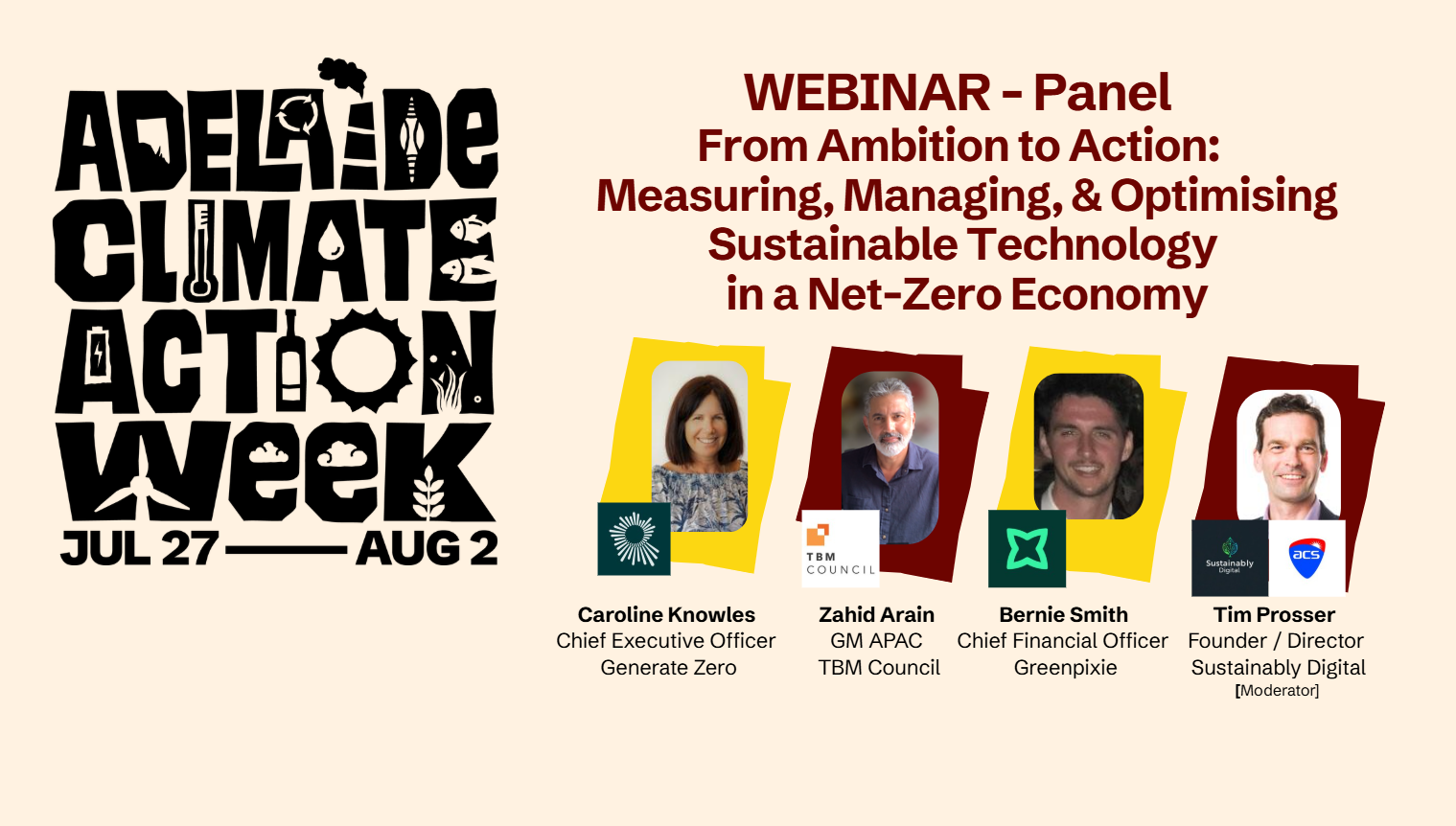
This was just one of the eye-opening statistics shared during our recent Adelaide Climate Action Week (ACAW) webinar, "From Ambition to Action: Measuring, Managing, and Optimising Sustainable Technology (ICT) in a Net-Zero Economy". Hosted by Maheshi Wadasinghe and moderated by Tim Prosser of Sustainably Digital, the session brought together a powerhouse panel to tackle the hidden emissions of our rapidly growing tech infrastructure.
The event saw incredible engagement from the audience. Our virtual crowd of seasoned sustainability, government, and finance professionals proved that the industry is hungry for actionable solutions to scale sustainable tech.
Here is a recap of the crucial insights shared by our expert panelists and the practical steps your organisation can take today.
The E-Waste and AI Elephant in the Room
Moderator Tim Prosser set the stage with a reality check on our digital consumption. Globally, the escalating electronic waste crisis is projected to generate 75 million metric tonnes of discarded technology in 2026. In Australia alone, citizens produce roughly three times the global average of e-waste, resulting in an estimated $430 million worth of recoverable precious metals buried in landfills each year.
Furthermore, as Artificial Intelligence adoption skyrockets, we are facing an "inconvenient truth": only 11% of global corporates publicly declare the environmental impact of their AI use. We are simultaneously hoarding digital waste—research shows that 90% of stored digital data is never accessed again after three months.
1. Close the "Compliance Gap" with Better Data
Caroline Knowles, CEO of Generate Zero, highlighted a major risk for businesses transitioning to mandatory climate disclosures. Standard technology provider reports (like those from Amazon AWS, Microsoft Azure, or Google Cloud) are simply not sufficient for audit and compliance.
These vendor reports often lack transparency, exclude water usage, rely on market-based estimates, and crucially miss Scope 3 (embodied) emissions—such as the hardware footprint of data centres, which typically only have a four-year lifespan. Caroline’s advice? Organisations need audit-ready, granular data that breaks down emissions by business unit and workload to properly plan reduction targets.
2. Implement "GreenOps" for Immediate Quick Wins
Bernie Smith, CFO at Greenpixie, explained how enriching raw cloud billing data line-by-line can transform an organisation's footprint. By mapping cloud usage to highly accurate carbon, energy, and water metrics, businesses can finally see the true cost of their IT.
Bernie advocates anchoring this measurement in energy (kilowatt-hours) first, because unlike carbon accounting, electricity usage is a hard metric that "can't be massaged".
Armed with this data, businesses can embrace "GreenOps" to tackle waste immediately. The top quick wins include:
Decommissioning zombie servers: Turning off idle cloud instances that people forgot were running.
Archiving or deleting cold data: Stop paying to "refrigerate a vast online attic" of unused storage.
Workload shifting: Moving non-urgent computing tasks to regions with cleaner, renewable energy grids (like South Australia or New Zealand).
3. Build the "Sustainability Triangle"
Zahid Arain, General Manager Asia Pacific for the Technology Business Management Council, drove home the point that sustainability shouldn't be a separate compliance exercise; it must be treated as Business As Usual (BAU).
A major theme that resonated with our audience—which was heavily represented by finance, tech, and sustainability experts—was the need for the "Sustainability Triangle." This requires breaking down silos and fostering deep collaboration between an organisation's IT, Finance, and Sustainability departments.
By assigning clear accountability for IT services to the actual business users and modelling environmental impact alongside financial costs, decision-makers can finally see the true ROI of Green IT. As Zahid noted, when you put sustainability data in front of executives alongside their financial data, they will naturally make smarter, more efficient choices.
The Next Step: Just Get Started
The overriding message from the panel was clear: don't wait for perfect data to begin.
If you want to treat your tech emissions with the same financial rigor as your traditional accounting, start with one material cloud or AI service. Create a baseline of its costs, consumption metrics, and users. Bring your finance, IT, and sustainability teams into the same room and start modelling the impacts.
As Caroline and Bernie reminded us: You can't manage what you don't measure. The raw billing data you need is already sitting in your organisation—it's time to leverage it, enrich it, and turn your net-zero ambition into action.
Resources:
Webinar replay - HERE
Frequently Asked Questions - From Ambition to Action Webinar (ACAW July 2026)
AI Energy & Sustainability Calculator - Explore what drives AI energy, carbon and water consumption.
Calculate your cloud's carbon, energy and water consumption, including your cloud providers' Scope 3 emissions.
TBM for Sustainability & ESG - Modelling Environmental Impact and Value with Financial Precision.
The Technology Business Management Council GreenOps Certification (Certified, Advanced, Leader for Organisations)
GreenOps Practitioner Course & Certification (for Individuals)
Self-Assessment Tool For Tech Teams- An ACAW Special Launch! Helps IT practitioners evaluate their current maturity in digital sustainability across people, process, and technology capabilities to identify skill gaps and set realistic professional development targets for the next 2 to 3 years.
Australian Computer Society: Professional association for Australia's information and communications technology (ICT) sector. [Link to ACS Sustainability]