System Dynamics of the Digital Boom: Why AI’s True Climate Cost is Hidden in the "Rebound"
Published on Sustainably Digital | September 1st, 2026
As Sydney, Melbourne, and Auckland rapidly establish themselves as the southern hemisphere’s primary digital infrastructure hubs, the technology and finance sectors across Australia and New Zealand are facing a dual mandate. On one hand, we are racing to deploy artificial intelligence (AI) to unlock unprecedented productivity and economic value. On the other hand, our organisations are striving to meet increasingly stringent national emission reduction targets and circular economy mandates.
How do we reconcile these two forces?
To help the professional community navigate this complex tension, MIT Sloan School of Management and the non-profit Climate Interactive recently launched a ground breaking update to the globally recognised En-ROADS Climate Solutions Simulator. For the first time, En-ROADS explicitly models the global energy, resource, and emissions pathways of data centres and AI from now until 2100.
For sustainability, technology, and finance professionals in Australia and New Zealand (ANZ), this tool provides a vital, evidence-based "systems thinking" framework to look beyond corporate carbon accounting and understand the real physical impact of digital expansion.
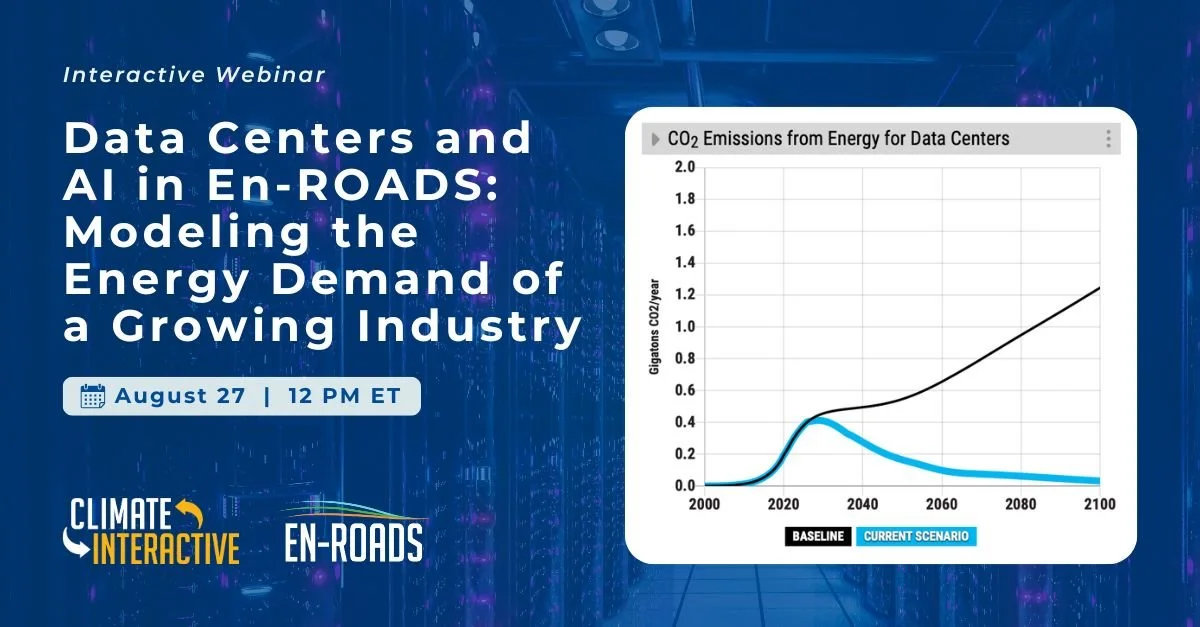
WEBINAR Replay - Data Centres and AI in En-ROADS (Click on Graphic to Play)
Here are the five core takeaways from this landmark research and how they apply directly to our regional market.
1. The Operational Baseline: A Rapidly Growing, Highly Concentrated Footprint
To ground the debate in hard numbers, En-ROADS establishes that in 2026, the global data centre industry consumes approximately 810 TWh of electricity annually. This accounts for roughly 2.5% of total global electricity consumption (and just under 1% of total final energy across all sectors). In terms of greenhouse gases, data centre operations are currently responsible for roughly 0.4 gigatons (Gt) of CO₂ emissions annually—a footprint comparable to the entire annual energy emissions of Mexico in 2023.
Without aggressive policy intervention, the En-ROADS baseline scenario projects that data centre electricity consumption will scale to nearly 6,500 TWh by 2100, driving annual operational emissions up to 1.25 Gt of CO₂.
The ANZ Perspective: While a global share of 2.5% of electricity might sound manageable, these averages mask the intense local geographic concentration of hyperscale facilities. In Australia’s National Electricity Market (NEM)—which remains heavily reliant on fossil fuels—and New Zealand’s hydro-dependent grid, the sudden addition of 100+ megawatt data centres can severely strain local transmission infrastructure. A single hyperscale data centre can draw as much electricity as 100,000 average households, creating localized grid challenges that regional utilities and corporate buyers must actively manage.
2. The Direct Rebound Effect: Why Efficiency Alone Won't Save Us
The tech sector frequently points to exponential hardware and software efficiency gains as proof that growth can be decoupled from emissions. The En-ROADS team reviewed the historical data and confirmed that the energy intensity of AI-specific computer chips has indeed fallen dramatically, with a modern chip using 99% less power to perform the exact same calculations as a model from 2008.
However, the model exposes two critical limits:
Physical Thermodynamic Walls: While chip efficiency has soared, average data centre Power Usage Effectiveness (PUE)—the ratio of total power used by the facility to the power delivered to the computing equipment—improved substantially through 2013 but has stalled around 1.54 globally since then. Data centre operators are hitting fundamental physical laws of thermodynamics in cooling and power distribution.
The Direct Rebound (Jevons' Paradox): As microchips, software algorithms, and data centre configurations become more efficient, the cost of training and running AI models plummets. Lower costs democratize access, which exponentially drives up the aggregate demand for computation. This is Jevons' Paradox in action: the efficiency improvements are overwhelmed by the explosion in total compute use, leading to a net increase in energy consumption.
The ANZ Perspective: Technology leaders in ANZ cannot simply rely on cloud providers upgrading to next-generation silicon to achieve corporate sustainability targets. Because efficiency gains make computing cheaper, demand will scale faster than efficiency can keep up, locking in a net positive demand on regional grids.
3. The Indirect Rebound: AI’s True Climate Threat is Macroeconomic
The webinar's most profound finding is that AI’s primary threat to safe climate thresholds does not come from the data centres themselves. Rather, it stems from AI’s role as a General-Purpose Technology (GPT)—similar to steam power or the steam engine in the industrial revolution—that drastically boosts productivity and accelerates economic growth across the wider global economy.
If we assume that AI successfully delivers a long-run economic productivity boost of 25% (a highly conservative estimate compared to some market forecasts), the En-ROADS simulator demonstrates a highly concerning feedback loop:
Increased Economic Activity: A larger, more productive economy drives up aggregate income, consumption, industrial manufacturing, transport, and construction.
Increased Fossil Fuel Lock-In: Because the global economy is still highly carbon-intensive, this broad-based economic growth dramatically increases energy demand across all non-AI sectors.
Stranded Asset Resuscitation: Under this high-demand scenario, uncompetitive fossil fuel assets (such as aging coal-fired power stations) that would have otherwise been retired and decommissioned are kept in service longer to meet the grid's capacity constraints.
Temperature Escalation: In the simulator, this indirect macroeconomic rebound drives global temperature warming from 3.3°C up to 3.6°C by 2100.
AI Economic Scenario in En-ROADS Global Operational DC Power (2100) Global Warming by 2100 Primary Driver of Increase
Baseline Scenario (No AI economic boost) ~6,500 TWh 3.3°C above pre-industrial Baseline industrial and consumer growth
High AI Scenario (25% economic boost) Scaled upward 3.6°C above pre-industrial Indirect Rebound: Economy-wide increase in manufacturing, transport, and fossil fuel lock-in
The ANZ Perspective: For finance and investment professionals, this highlights a massive systemic risk. Promoting AI-driven productivity as a pure financial benefit without accounting for its "carbon debt" is a major blind spot. If AI-driven logistics or supply chain tools are used to optimize oil and gas extraction—which is already happening globally today—the technology actively undermines national decarbonisation pathways.
4. Paper vs. Physical Decarbonisation: Corporate Claims and the Additionality Problem
The research directly addresses a growing point of friction in corporate ESG reporting: how hyperscalers account for their power. A prominent case study discussed was Amazon's $650 million acquisition of a data centre campus in Pennsylvania directly connected to an existing nuclear power plant. Under standard greenhouse gas accounting protocols (Scope 2), Amazon can legally claim this facility is powered by 100% "carbon-free" energy.
However, the laws of physics do not respect accounting templates. Because that nuclear plant was already operating at maximum capacity, siphoning its baseline electricity off the public grid to run the data centre forces the surrounding regional grid (the PJM market) to ramp up marginal fossil fuel generators—specifically coal and gas—to meet the needs of regular citizens and local businesses.
This dynamic has two direct consequences:
Net Emissions Increase: It increases net system-wide greenhouse gas emissions while allowing the corporate buyer to report "net zero" operations.
Social Equity & Backlash: By occupying existing cheap, clean energy, data centres force utility companies to build expensive new grid infrastructure, the costs of which are often passed directly to regular ratepayers [92]. This is driving an intense public backlash (frequently referred to as "NIMBY" or "BANANA"—Build Absolutely Nothing Anywhere Near Anything).
The ANZ Perspective: ANZ finance and sustainability directors must look beyond paper-based Power Purchase Agreements (PPAs) that merely shuffle existing green electrons. True decarbonisation requires additionality—contracting new, incremental renewable generation and storage capacity onto the grid, rather than cannibalising existing clean baseload. It also requires careful social governance to ensure data centre developments do not drive up local public electricity rates or cause local grid instability.
5. Hard Ecological Boundaries: Water, Materials, and the Circular Economy
While greenhouse gases dominate the corporate conversation, data centers carry immense local environmental and social footprints that fall outside traditional carbon accounting [91]. The En-ROADS research highlights three critical areas of physical resource strain:
Water Intensity: Data centers require continuous cooling. A single large hyperscale facility can consume as much water as a town of 10,000 to 50,000 people.
Extreme Material Extraction: The digital economy is fundamentally physical. Producing a single, lightweight 2-kilogram computer requires the extraction of roughly 800 kilograms of raw materials—including rare earth elements that are frequently mined in highly destructive ways.
E-Waste Accumulation: Because data centres run highly demanding workloads, hardware components have extremely short operational lifecycles [91]. This rapid turnover generates millions of tonnes of electronic waste, which contains hazardous heavy metals like lead, mercury, and cadmium that pose severe public health and environmental risks if not managed through rigorous circular supply chains.
The ANZ Perspective: In Australia, one of the driest inhabited continents on earth, building water-cooled data centers in drought-prone or water-stressed regional basins is highly high-risk. ANZ technology professionals must champion circular procurement frameworks, demanding that hardware vendors provide transparent lifecycle data, support hardware longevity, and guarantee closed-loop recycling systems to prevent e-waste from entering local landfills.
Moving Forward: The Policy and Systems Imperative
The core message from MIT and Climate Interactive is clear: there is no purely technological solution to this crisis . While AI can accelerate the discovery of clean energy breakthroughs and optimize smart grids, these technological benefits come with long development, permitting, and scaling delays. Meanwhile, the emissions and resource footprints of data centers are accumulating in the atmosphere and our local environments today.
To bridge this gap, technology, finance, and sustainability professionals across Australia and New Zealand must move away from isolated, siloed decision-making and embrace a system-dynamics view:
Grid Decarbonisation is the Master Key: The carbon footprint of any data centre is directly tied to the carbon intensity of the grid it plugs into. We must advocate for policies that aggressively transition our regional power grids to zero-carbon renewable energy with storage.
Adopt Systemic ESG Auditing: Financial and sustainability analysts must start evaluating the "systemic additionality" of corporate renewable energy contracts, penalising greenwashing that simply siphons clean power away from regular grid users.
Advocate for Strong Macro Policies: To curb both direct and indirect rebound effects, we must support broad-based economy-wide climate policies. En-ROADS demonstrates that the most effective tool to safely guide our digital transformation is a robust, transparent carbon price where revenues are rebated to the public—neutralising the carbon debt of AI's economic boost while protecting vulnerable citizens.
By utilizing the free, fully open-source En-ROADS simulation model within our organisations, we can build the systems-thinking capability needed to design a truly sustainable, digitally enabled future.
The transition will not be simple. But as the researchers of this landmark model remind us:
"It's not going to be easy, but it's going to be worth it."
The En-ROADS Data Centres and AI module is fully documented, free to use, and available in over two dozen languages at en-roads.org.
Resources:-
Data Centers and Artificial Intelligence in En-ROADS [Climate Interactive Explainer Article]
YouTube Webinar Replay - ‘Data Centers and AI in En-ROADS’ [Climate Interactive]