Digital Speed, Physical Limits: The Tech, Finance, and Sustainability Playbook from the 2026 Climate Governance Forum
Published on Sustainably Digital | September 3rd, 2026
The transition to a low-carbon economy is no longer a distant line item on a corporate sustainability agenda. As Australian boards and executives navigate a highly volatile macroeconomic and regulatory landscape, climate governance has undergone a fundamental shift. It has moved from a specialised, siloed ESG practice to a core pillar of corporate strategy and risk management.
At the Australian Institute of Company Directors (AICD) Climate Governance Forum 2026, held on 28th August in Melbourne, directors, regulators, and industry experts gathered under the banner "A Future Worth Making". The central message of the forum was clear:
“the next short decade—not 2040 or 2050—is where the future of Australia’s industrial and digital economy will be determined”.
For professionals operating at the intersection of technology, finance, and sustainability, the forum exposed critical tensions, structural shifts, and strategic opportunities. Here is your playbook from the front lines of climate governance 2026.

1. The Technology Frontier: Navigating the 'Digital-Sustainability Paradox'
For IT leaders, Chief Technology Officers, and digital managers, the forum delivered a sharp dose of physical reality: digital transformation is not weightless; it has a massive, resource-intensive physical footprint.
Data Centres as the "New Smelters"
The rapid, unchecked adoption of AI and high-compute workloads is driving unprecedented electricity demand. Lucia Cade, Chair of Infrastructure Victoria, highlighted that data centres have replaced traditional heavy industries (like aluminium smelting) as the primary concern for electricity grid consumption. Indeed, data centres are projected to consume 13% of Australia’s electricity by 2035.
This creates what the forum termed the Digital-Sustainability Paradox: while organisations leverage digital tools to drive efficiency and emissions tracking, the underlying infrastructure of these tools actively threatens their net-zero targets.
Technology Speed vs. Construction Speed
Sabooh Whitelaw, APAC Energy Solutions leader at AirTrunk, highlighted a fundamental structural mismatch: digital innovation and AI advance at "technology speed" (measured in months), whereas the grid infrastructure needed to support them moves at "construction speed" (measured in years of planning, approvals, and long-term project delivery).
Boards and technology teams often approve AI strategies without addressing this infrastructure gap. Every "green cloud" strategy assumes that firmed, low-cost renewable energy, water, and network capacity will always be available. In reality, these assumptions are rarely explicit in the tech roadmaps presented to boards.
The AI Economic Inversion and Resource Trade-offs
Moreover, the economics of AI data centres are completely inverted compared to traditional cloud setups. Kee Wong, Director at AEMO and CAR Group, explained that traditional cloud facilities have 80% of their costs in long-term infrastructure (20-to-25-year horizons) and only 20% in CPUs. AI data centres flip this: 80% of the investment is in GPUs that become obsolete in approximately four years, while only 20% is in the physical structure. This radically changes capital depreciation and retrofitting models.
Additionally, tech professionals must grapple with a stark, technology-agnostic engineering trade-off between energy and water:
Water-cooled data centres use significantly less electricity but consume massive volumes of water.
Dry campuses use no water but demand far higher amounts of grid energy.
The Tech Leader’s Action Items:
Establish Sustainability Non-Functional Requirements (NFRs): Do not sign cloud or data centre Master Services Agreements (MSAs) without strict, binding metrics for Power Usage Effectiveness (PUE), Water Usage Effectiveness (WUE), and 24/7 Carbon-Free Energy (CFE) targets.
Implement "Tokenomics" and Compute Rationalisation: Work with your architecture teams to justify high-compute models (like Large Language Models) over smaller, task-specific, energy-efficient expert models to optimise compute budgets and minimise emissions.
Governing Scope 3 AI Emissions: Demand rigorous data provenance and supply-chain transparency from your digital infrastructure providers to ensure Scope 3 AI emissions are not being underestimated.
2. The Finance Frontier: Elevating Reporting from Compliance to Strategy
For CFOs, finance directors, and compliance teams, the forum brought a mixture of reassurance and a stern warning: the era of treating climate disclosures as a simple compliance checklist is officially over.
"We Survived Year One" (ASIC’s Reality Check)
With the first year of mandatory climate reporting (AASB S2) in Australia successfully completed, Claire LaBouchardiere (ASIC) and Emma Newnham (Mallesons) shared a reassuring takeaway: organisations survived. The quality of climate reporting across the first cohort of Australian companies has shown noticeable, measurable improvement.
However, many organisations were caught off-guard by the high level of subjectivity required in principles-based, ISSB-aligned disclosures. Unlike traditional financial reporting which is governed by highly prescriptive, rule-based systems, climate reporting requires substantial judgment calls regarding scenario analysis, climate-related financial impacts, and materiality.
Sustainability Records Carry Legal Weight
A critical compliance message from Year One is that sustainability records are now legally required corporate documents. Under Australian law, organisations must maintain robust documentation that supports all assumptions, calculations, and judgment calls made in their public sustainability reports. These records are essential for discussions with auditors and will be the first files requested by ASIC in regulatory inquiries.
Furthermore, ASIC’s review of the first cohort identified six key opportunities for disclosure enhancement:
Clearly distinguishing mandatory disclosures from voluntary ones.
Being explicitly transparent about assumptions and underlying judgments.
Avoiding overly broad, defensive disclaimers that imply investors cannot rely on the data.
Strictly adhering to cross-referencing rules.
Properly disclosing targets (including mandatory regulatory targets like the Safeguard Mechanism).
Ensuring complete narrative and data consistency across all reporting documents.
Disclosures as a CapEx "Decision Tool"
The true value of climate reporting is realised when it transitions from an expensive compliance exercise into a strategic decision tool that improves the bottom line and reshapes corporate capital allocation.
Jane McAloon, Chair of BlueScope, argued that mandatory climate reporting is the single best opportunity boards and finance leaders have to make their corporate strategies and trade-offs explicit on the public record. By integrating scenario analysis directly into Capital Expenditure (CapEx) guidelines, finance teams can stress-test investments against rapid transition pathways, preventing the creation of stranded assets.
The Finance Professional’s Action Items:
Formalise Cross-Functional Working Groups: Avoid sending climate disclosures to legal or finance teams at the last minute. Establish an integrated, cross-sectional working group comprising finance, risk, legal, and operational leads reporting directly to an executive steering committee.
Audit-Ready Sustainability Records: Establish formal data provenance controls for all climate-related inputs, especially when utilising AI to compile emissions data, to ensure all public figures can be legally verified and audited.
Adopt "Prudent Realism" Over Ambition: Avoid being at the "bleeding edge" in the early years of compliance. Focus on qualitative statements unless quantitative targets are backed by robust, third-party verified data.
3. The Sustainability Frontier: Climate Governance Is Simply Governance
For Chief Sustainability Officers, ESG directors, and climate leads, the forum offered a powerful conceptual reframing: climate governance is not a separate discipline or sub-branch of board duties; it is simply governance in a world of deep uncertainty.
Naming the Enablers
Jane McAloon shared BlueScope's experience of balancing commercial realism with ambitious decarbonisation, such as their $1.3 billion blast furnace upgrade at Port Kembla. BlueScope’s governance under pressure has been guided by a robust, repeatable framework: the Five Enablers. Rather than focusing on a distant, unfunded 2050 net-zero target, sustainability leads must identify and constantly re-evaluate these enablers:
Technology Evolution: Managing a portfolio of technological options and knowing when to pivot.
Affordable, Firmed Renewable Electricity: Securing reliable energy supply to support heavy operations.
Transition Fuels: Bridging the gap with gas, hydrogen, or carbon capture.
Raw Materials Compatibility: Ensuring supply chains can support green manufacturing.
Stable, Fact-Based Public Policy: Advocating for regulations that support sovereign capability rather than driving "deindustrialisation by stealth".
Transition Costs vs. The Price of Inaction
CSOs have a vital role to play in correcting the dominant corporate narrative, which focuses excessively on the immediate capital costs of transitioning. The forum emphasised that the potentially catastrophic cost of inaction deserves equal board attention. With 2030 just over three years away and physical climate events accelerating, boards must evaluate and communicate the long-term operational and financial consequences of delayed action.
First Nations Knowledge as Risk Intelligence
A major highlight of the forum was the shifting paradigm around First Nations engagement. Brian Bero (Principal Lawyer, Jaramer Legal) and Ann Sherry (Co-Chair, Climate Leaders Coalition) urged boards to shift from asking "who do we consult?" to "what governance systems are we entering into?".
Traditional Indigenous knowledge should not be treated as free data to extract, but as highly sophisticated risk intelligence. For example, savanna burning programs combine centuries-old cultural fire management with advanced satellite tracking to measure carbon abatement and generate high-integrity carbon credits, while simultaneously protecting biodiversity and creating remote jobs.
The Sustainability Leader’s Action Items:
Move from Consultation to Governance Partnership: Respect the distinct authorities of First Nations entities (such as PBCs, land councils, and ranger groups) and design joint-venture SPVs with equity sharing to de-risk approvals and build lasting social license.
Embed Nature and Biodiversity Now: Do not treat nature as a tomorrow problem. Water security, resource limits, and the irreversibility of biodiversity decisions make nature-positive frameworks (such as TNFD) material to your organisation today.
Test the "CEO and Strategy Day" Gateways: The ultimate test of your climate governance is whether climate risks are integrated into your annual corporate strategy day and whether your CEO recruitment process actively tests climate and energy literacy.
The Decisive Decade
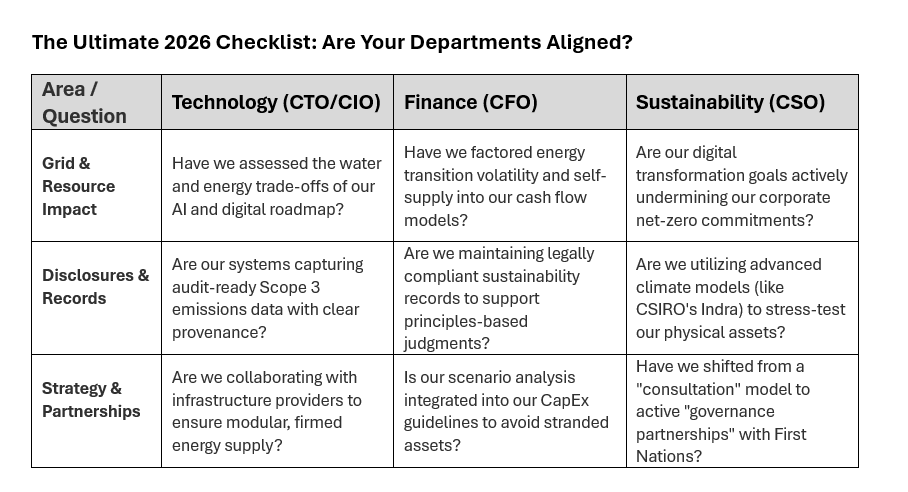
Governing through transition is not about waiting for total clarity or perfect technological solutions—it is about making sound, long-term capital and infrastructure commitments under conditions of deep, structural uncertainty. By breaking down departmental silos and integrating the technical, financial, and environmental components of climate transition, Sustainably Digital organisations can turn regulatory compliance into an enduring competitive advantage.
Resources;