From "Black Box" to Green Ledger: Unlocking Digital Sustainability with TBM
As sustainability practitioners, we are experts at tracking electrons, molecules, and social impacts across vast supply chains. We can audit a factory floor or calculate the carbon intensity of a logistics fleet with increasing precision. Yet, for many of us, one critical area of the enterprise remains a stubborn "black box": Information Technology.
We know IT has a footprint. We know data centers consume massive amounts of energy and that e-waste is a growing crisis. But when we ask IT for data, we often get a single monthly electricity bill or a lump-sum cloud invoice. We lack the granularity to answer the critical question: Which specific business activities are driving these emissions?
This is where a framework known as Technology Business Management (TBM) becomes a game-changer for the sustainability office. While TBM was originally designed for financial transparency, its latest iteration (Taxonomy 5.0) has evolved into a powerful tool for environmental accountability.
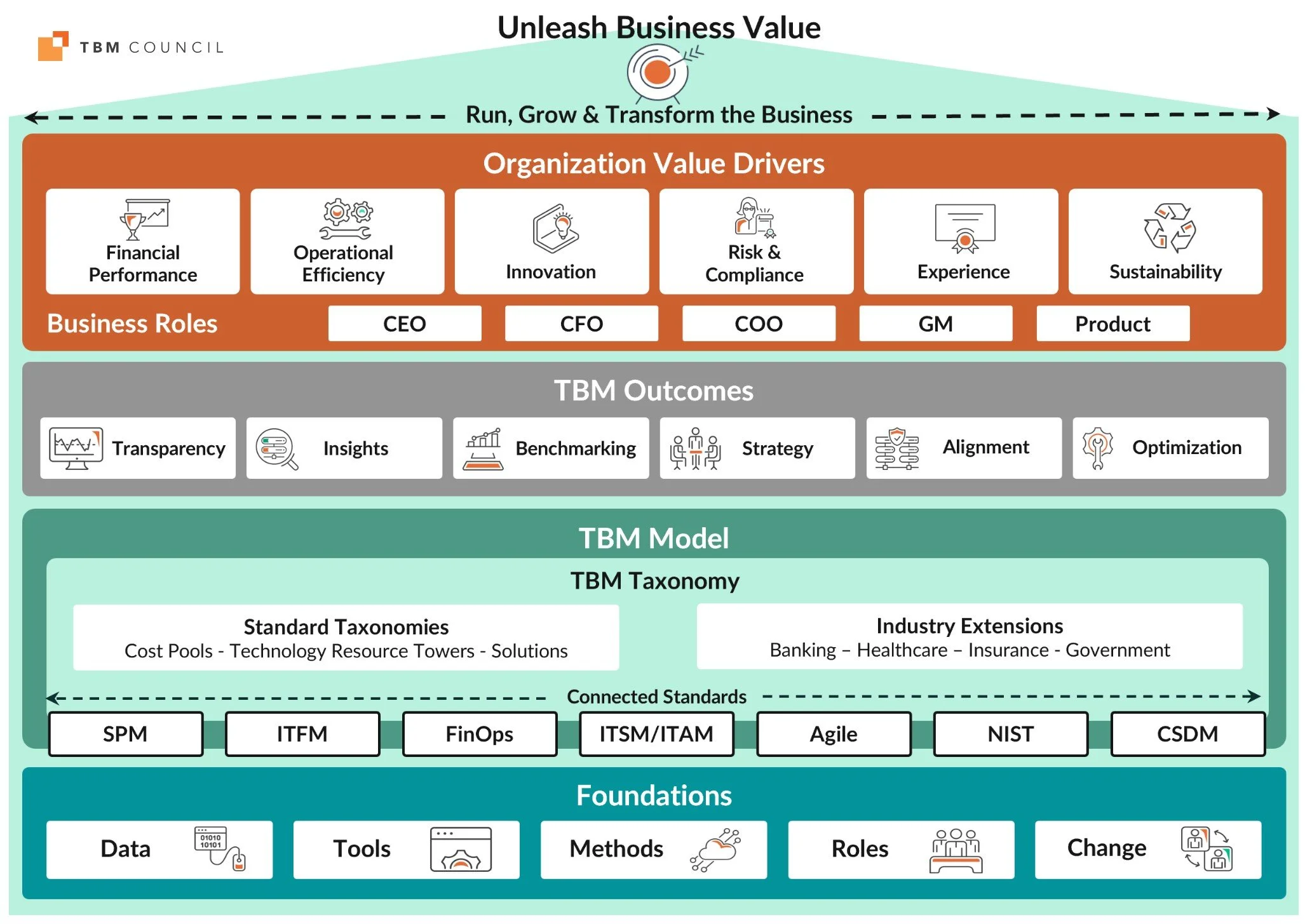
Technology Business Management (TBM) Framework
What is TBM? (And Why Should a CSO Care?)
Think of TBM as a translation layer. Historically, IT speaks in technical terms (servers, storage, millions of lines of code), while Finance speaks in general ledger terms (hardware depreciation, software licenses). TBM provides a standard taxonomy to map those technical assets directly to the business capabilities they support.
For a sustainability professional, this is the missing link. It allows you to move from Sustainability of IT (viewing IT as a monolithic cost centre) to Sustainability by IT (understanding how digital choices drive business value and environmental impact).
Here is how leveraging the TBM Taxonomy can transform your digital sustainability strategy:
1. Granularity: Moving Beyond "Average" Emissions
Standard sustainability reporting often relies on spend-based estimates or broad averages. TBM breaks this down. By using the Cost Pool and Technology Resource Tower layers of the taxonomy, you can identify exactly what you are consuming—distinguishing between energy-hungry on-premise data centres, public cloud services, and end-user hardware.
This enables you to pinpoint "hotspots." You might discover that while your overall cloud spend is flat, your consumption of high-carbon AI compute resources (a specific sub-tower in the taxonomy) has spiked. This level of detail transforms a vague "reduce emissions" goal into a specific, actionable target.
2. The "GreenOps" Advantage: Linking Cost and Carbon
In the world of cloud computing, cost and carbon are often proxies for one another. Wasteful code that runs inefficiently costs more and burns more electricity.
TBM aligns perfectly with GreenOps (Green Operations). By attributing costs to specific applications or business units, you create accountability. When a business unit leader sees that their specific application is responsible for a disproportionate share of the carbon budget, they are incentivised to optimise. TBM provides the structure to report this data, allowing you to present a "carbon invoice" alongside the financial one.
3. Visibility into the AI Boom
The explosive growth of Generative AI presents a new sustainability challenge. AI workloads are incredibly resource-intensive regarding energy and water. The TBM Taxonomy 5.0 has introduced specific categories for Artificial Intelligence within the Solutions layer.
This means you can specifically track the cost and resources allocated to Generative, Predictive, or Agentic AI models. For a CSO, this is vital. It allows you to assess the "Return on Sustainability Investment." Is the environmental cost of a massive Large Language Model (LLM) justified by its business value, or could a smaller, more efficient model suffice? TBM gives you the data to ask that question.
4. Scope 3 Transparency
For most organisations, the vast majority of digital emissions fall under Scope 3 (the supply chain). This includes the "embodied carbon" of the hardware you buy—the emissions generated during manufacturing before the device is ever turned on.
TBM facilitates better hardware lifecycle management. by categorizing assets clearly (e.g., End User Compute, Smart Devices), you can track refresh cycles more accurately. Extending the life of a laptop from three years to four years can reduce annualised emissions by up to 33%. TBM data helps you build the financial and environmental business case for these circular economy initiatives.
The Path Forward: A Shared Language
The biggest barrier to sustainable IT is often the language barrier between the CIO, the CFO, and the CSO. TBM tears down that wall.
By adopting this standard taxonomy, you stop having disjointed conversations about "servers" versus "carbon." Instead, you have a unified conversation about value. You can see exactly which digital services are driving the business forward and what their true environmental cost is.
As we move toward rigorous reporting requirements like the EU’s CSRD, this transparency is no longer a luxury; it is a necessity. It is time to open the IT black box and start accounting for our digital future with the same rigor we apply to the rest of our business.
References