CASE STUDY: UK Gov Unlocking Hidden Tech Carbon: Insights for Australian Tech Leaders
For digital sustainability practitioners and technology leaders across Australia, the pressure is on. With the Australian Government committing to Net Zero in Government Operations by 2030, and the private sector ramping up regulated non-financial climate reporting, we can no longer afford to look only at our electricity bills (Scope 2).
The real challenge—and the biggest opportunity—lies in Scope 3 emissions.
A recent insights report released by the UK Government Digital Sustainability Alliance (GDSA) offers a comprehensive roadmap for tackling these elusive emissions. While the report hails from the UK, its frameworks are universally applicable and provide a gold standard for Australian organisations grappling with their digital supply chains.
Here is a breakdown of the key insights from the report and how we can apply them to the Australian technology landscape.
The Scope 3 Reality Check
The report opens with a stark statistic that every CIO and Sustainability Lead needs to internalise:
"In most departments, scope 3 will typically represent 70% to 90% of the total digital carbon footprint."
For Australian organisations, which rely heavily on imported hardware and global cloud services, this figure is critical. These emissions encompass the full lifecycle of ICT goods—from the mining of raw materials and manufacturing (embodied carbon) to transportation, use-phase services, and end-of-life treatment.
If you are only reporting on your data centre energy usage, you are missing the vast majority of your environmental impact.
A High-Level Action Plan
The GDSA report moves beyond theory into a practical "Operate and Improve" model. It suggests a three-phase approach to managing digital sustainability:
Set Up and Establish: Define the baseline. You cannot manage what you do not measure. This involves identifying all assets and services and establishing a carbon baseline, not just a financial one.
Operate and Improve: Engage procurement and suppliers. This involves shifting from passive consumption to active management of supplier emissions.
Optimise: Retain and re-use. This is the circular economy in action.
Key Reduction Measures: The "Big Wins"
Based on the research, here are the most effective levers we can pull to reduce ICT emissions immediately:
1. The "Sweat the Assets" Strategy
The report explicitly advises against arbitrary refresh cycles (e.g., automatically replacing laptops every 3 years). Instead, organisations should:
Keep assets as long as possible: Replace based on performance metrics or user experience, not device age.
Profile your ICT: "Right-size" technology to the role. Does a general admin user need a high-performance workstation? Over-provisioning is a carbon leak.
2. Sustainable Procurement
Procurement is the gatekeeper of Scope 3. The report suggests making product-level accountability a minimum requirement for tenders.
Scrutinise Data: Don't accept generic spend-based carbon data if specific product data is available.
Buy Second Life: actively seek opportunities to purchase remanufactured or refurbished equipment.
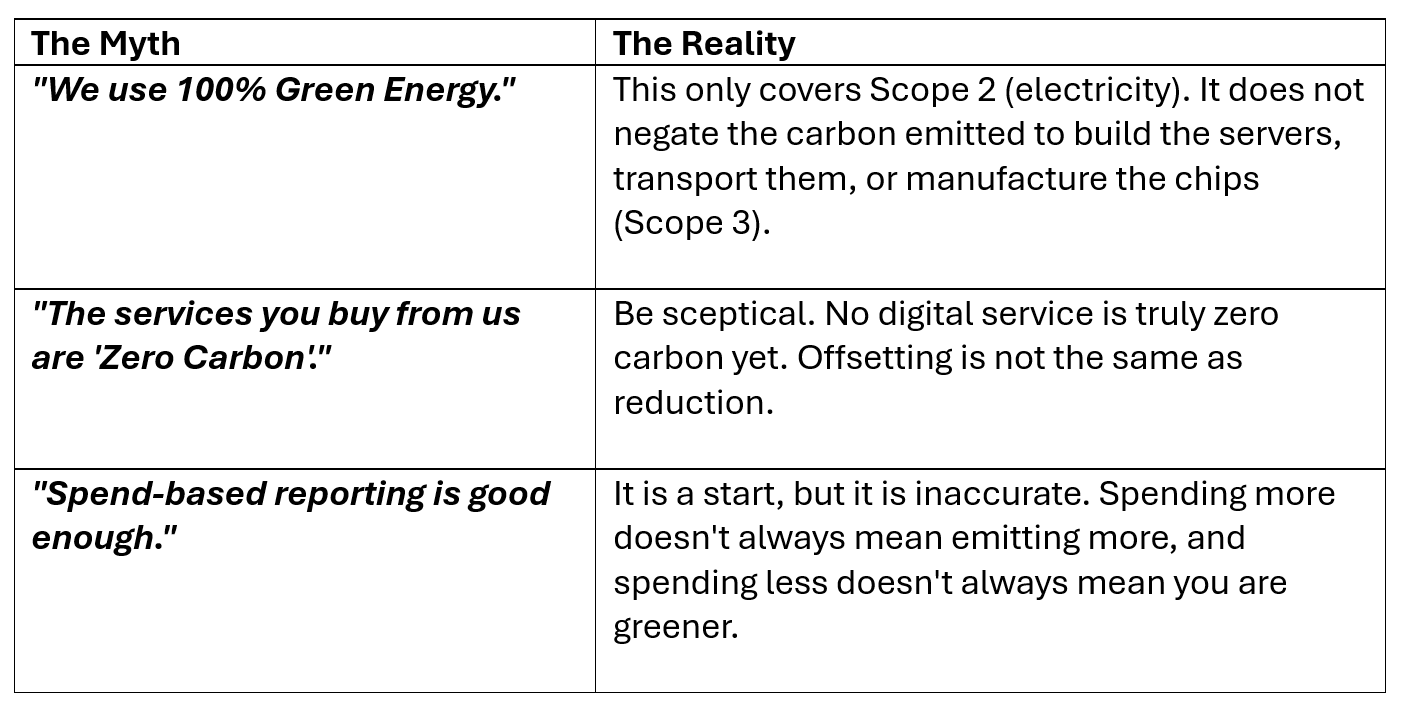
3. Myth Busting: Green Energy ≠ Zero Carbon
One of the most valuable sections of the report resolves common misconceptions that often stall progress.
Application for the Australian Market
How do we take these GDSA insights and apply them Down Under?
Align with Federal Targets: Use this report to support compliance with Australia’s tightening climate disclosure standards.
Challenge Global Suppliers: Australian tech buyers often feel small compared to US or EU markets. However, by adopting the rigorous data scoring methodologies outlined in this report, we can join the global demand for transparency.
Focus on Logistics: Given our geographic location, the "transport" component of Scope 3 is significant. Extending device life reduces the frequency of shipping, which has a compounded benefit for Australian companies.
The Checklist
To get started, the GDSA report suggests a clear path forward. Here is a quick code snippet of the strategy you can integrate into your planning documents:
Digital Sustainability Action Plan (Draft)
1. Phase 1: Baseline
[ ] Audit all physical ICT assets.
[ ] Audit all Cloud/SaaS subscriptions.
[ ] Calculate current Scope 3 baseline using available data.
2. Phase 2: Procurement Changes
[ ] Update tender documents to require product-level carbon data.
[ ] Introduce "Right-to-Repair" weighting in scoring.
[ ] Mandate "Second-Life" consideration for non-critical hardware.
3. Phase 3: Culture & Usage
[ ] Extend hardware refresh cycles by 12-24 months.
[ ] Educate users: "Green energy does not mean zero impact."
Conclusion
The GDSA Digital Scope 3 Insights Report is a wake-up call. It confirms that we cannot buy our way to net zero simply by purchasing offsets or green energy tariffs. We must do the hard work of extending hardware life, interrogating supply chains, and demanding better data.
For Australian practitioners, this is the blueprint we have been waiting for. Let’s turn these insights into action.
References