Bridging Climate Commitments and Operational Reality: Launching the SFIA 9 Sustainable Technology and GreenOps View
Over the past six months, I have had the privilege of globally leading an initiative to solve one of digital transformation's most persistent challenges: how to translate high-level environmental commitments into actionable, durable workplace capabilities.
Today, I am thrilled to officially announce the launch of the Sustainable Technology and GreenOps view in SFIA 9.
Whether you lead a sustainability practice, manage technology budgets in finance, architect cloud platforms, or direct procurement, this framework was designed to align our collective efforts. Here is an overview of what the new SFIA 9 view brings to the industry and how your organization can leverage it.
What is the SFIA Foundation and Framework?
For professionals new to the framework, SFIA (Skills Framework for the Information Age) is overseen globally by the not-for-profit SFIA Foundation. Used across more than 180 countries and translated into 12 languages, SFIA serves as the world’s leading common language for describing digital, data, and technology capabilities.
SFIA evaluates competencies using a two-dimensional grid: specific professional skills mapped across 7 Levels of Responsibility—ranging from Level 1 (Follow) up to Level 7 (Set Strategy, Inspire, and Mobilise). These levels describe progressive autonomy, influence, complexity, and business attributes.
To help organisations navigate specialised domains, SFIA Views group relevant skills for specific contexts or audiences without altering the underlying, durable skill definitions.
Unveiling the SFIA 9 Sustainable Technology and GreenOps View
Digital products, cloud infrastructure, and software engines generate environmental impacts across their entire lifecycle. However, attempting to solve these challenges solely through operational activity or isolated "sustainability dashboards" often stalls progress because authority and decision rights remain disconnected from the findings.
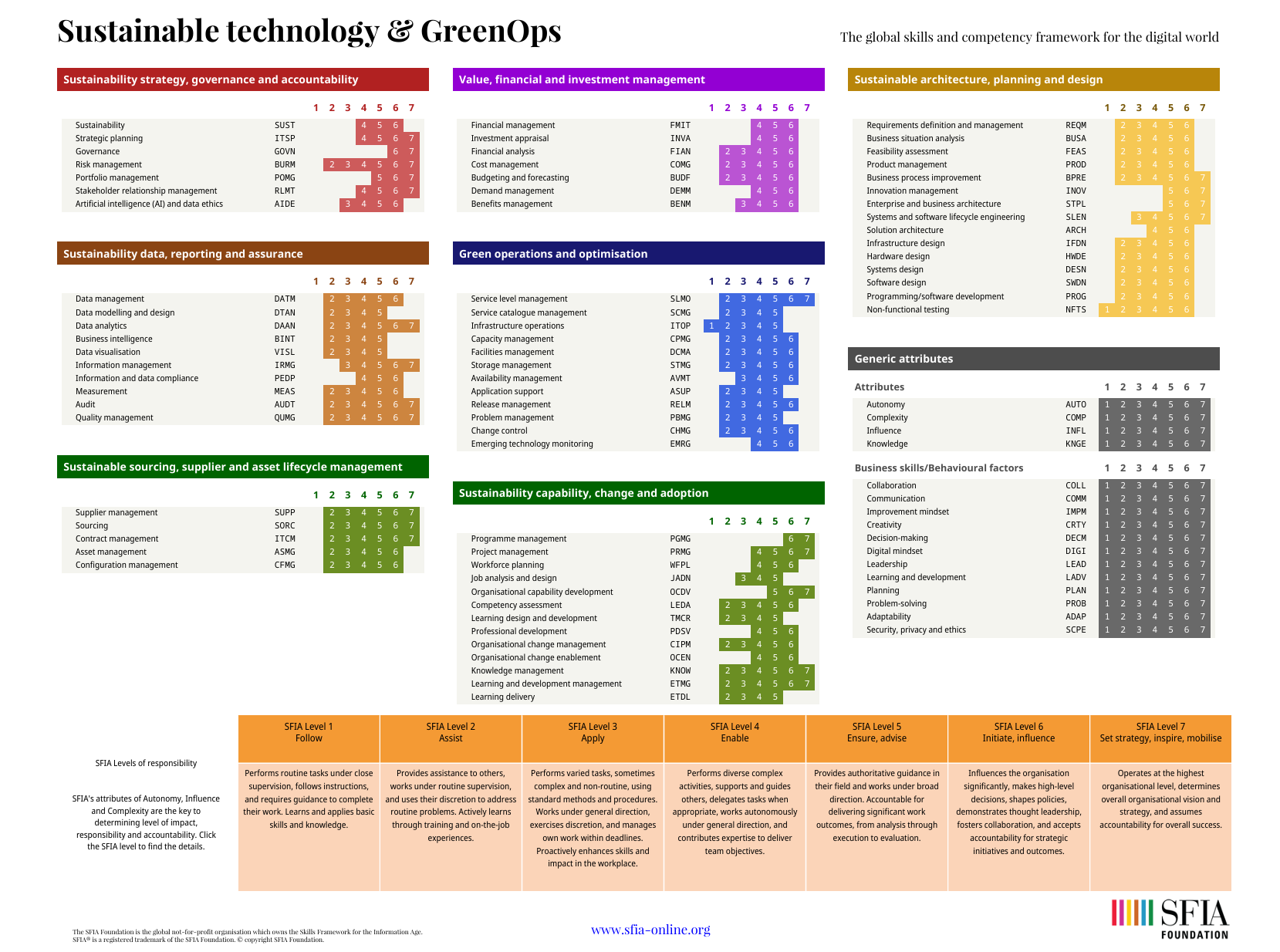
The Sustainable Technology and GreenOps view acts as an operational bridge. It maps 58 core organisational needs directly to 69 distinct SFIA skills. Rather than inventing transient job titles, the view demonstrates how sustainability is delivered by combining established professional capabilities across strategy, finance, architecture, operations, data, procurement, and governance.
The Seven Organisational Need Categories
To help teams navigate the framework, the 58 organisational needs are structured into seven comprehensive categories:
Sustainability strategy, governance and accountability: Establishing environmental direction, risk management, decision rights, oversight, and stakeholder accountability.
Value, financial and investment management: Integrating cost, business demand, budgeting, and investment appraisal directly with environmental impact and avoided carbon.
Sustainable architecture, planning and design: Evaluating sustainability requirements and design trade-offs before technical choices become fixed or difficult to change.
Green operations and optimisation: Driving resource efficiency, capacity rightsizing, and continual optimisation across services and IT infrastructure.
Sustainability data, reporting and assurance: Establishing reliable measurement, data lineage, calculation quality, ESG reporting, and audit assurance.
Sustainable sourcing, supplier and asset lifecycle management: Embedding environmental criteria across vendor selection, contracts, data rights, hardware refresh, and asset circularity.
Sustainability capability, change and adoption: Structuring role design, workforce skills development, learning pathways, and organisational change management.
The 12 Core Archetype Role Profiles
A central message of this project is that many decisions driving technology's footprint are made outside IT departments—in finance, procurement, facilities, and business service ownership.
To illustrate how accountability flows across functions, the view introduces 12 archetype role profiles utilising 30 core SFIA skills across 52 skill assignments. These profiles are split between core technology roles and essential cross-functional partners:
7 Core Technology Roles
GreenOps Analyst (Level 3): Analyses consumption trends, validates telemetry, and implements routine optimisations within agreed limits.
Senior GreenOps Analyst / Specialist (Level 4): Owns baseline calculation methods, tests supplier/cloud evidence quality, and enables consistent practice.
GreenOps Lead (Level 5): Governs the GreenOps practice across an estate, builds business cases, and connects findings to decision owners.
Infrastructure & Cloud Operations Manager (Level 5): Sets utilization standards, manages real capacity demand, and integrates environmental impact into change control.
Solution Architect (Level 5): Factors energy and lifecycle consequences into architecture trade-offs before systems are built.
Software Engineering Lead (Level 5): Establishes efficient coding standards and builds resource-efficiency testing directly into delivery pipelines.
Accountable Technology Owner (Level 7 - e.g., CIO/CTO): Sets enterprise strategy, allocates resources, and assumes overall accountability for technology's environmental outcomes.
5 Cross-Functional Roles Outside Technology
Technology Procurement Lead (Level 5): Secures contractual data rights, evaluates whole-life cost/impact, and enforces supplier sustainability terms post-award.
Finance Business Partner / FinOps Lead (Level 5): Brings cost and carbon together in financial models, business cases, and consumption showback.
Business Service Owner (Level 6): Controls demand by challenging availability tiers, data retention, and retiring low-value services.
Sustainability Lead (Level 6): Establishes organizational ESG policy, oversees public claims, and ensures data lineage back to technology sources.
Estates or Data Centre Facilities Manager (Level 5): Manages site power, cooling, water efficiency metrics (PUE/WUE/CUE), and facility load.
Diagnosing Organisational Gaps
One of the most immediate benefits of adopting this framework is its ability to serve as a diagnostic tool. When sustainability initiatives stall, SFIA helps leaders pinpoint the exact issue:
Capability Gap: The required professional skill or baseline method is missing or underdeveloped.
Integration Gap: Capabilities exist independently, but evidence and hand-offs fail to connect across functions (e.g., IT and Facilities holding separate data).
Accountability Gap: Operational teams identify waste, but no one with decision authority over budgets, contracts, or standards owns the decision.
Getting Started
Whether your organisation plans to embed these competencies into existing roles, deploy a specialist team, or use a combined model, the SFIA 9 Sustainable Technology and GreenOps view provides an adaptable, standardized foundation.
I encourage you to explore the full view and role profiles on the SFIA Foundation website. Let’s move beyond passive reporting and build the durable professional capabilities required for a truly sustainable digital future.
References;