BOOK Review: Sustainable IT Playbook
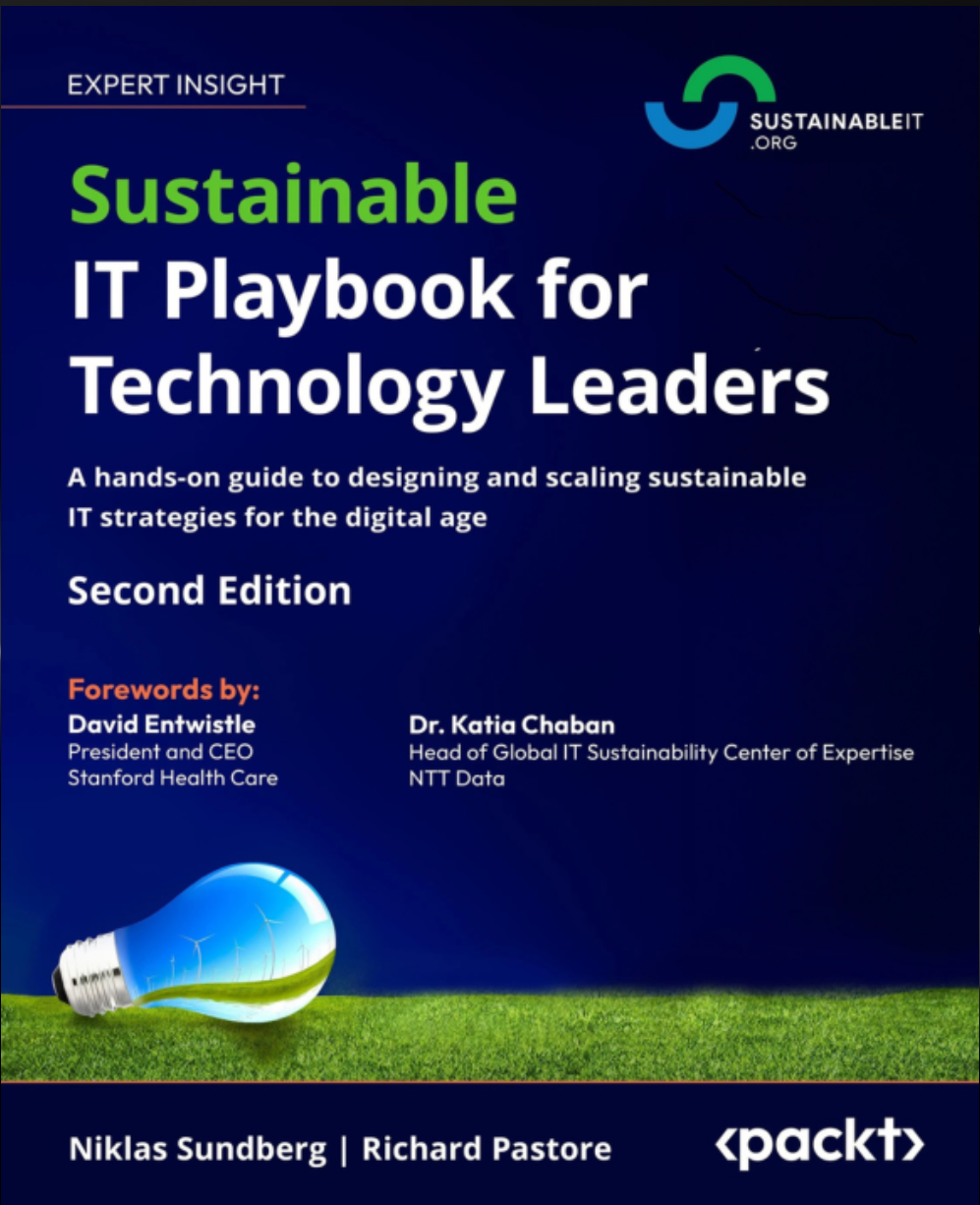
Title: Sustainable IT Playbook for Technology Leaders (Second Edition)
Authors: Niklas Sundberg, Richard Pastore;
Foreword by David Entwistle and Dr. Katia Chaban
The Sustainable IT Playbook for Technology Leaders presents itself as a consequential guide for an era where climate responsibility cannot be separated from digital progress. In its second edition, the book ambitiously reframes IT leadership as a domain where sustainability is not a peripheral KPI but the core of strategic decision-making.
The editors Sundberg and Pastore, with forewords from established voices, deliver a practical, action-oriented trajectory for technology leaders who must align innovation with environmental accountability.
What the book sets out to do, it largely achieves. It is structured around a clear three-part framework—why, what, and how—that helps readers move beyond abstract rhetoric toward tangible impact.
Part I grounds readers in the urgency of climate challenges and the planetary boundaries that IT operations touch, establishing the ethical and business case for sustainable transformation.
Part II translates this rationale into concrete actions: how to optimise workloads, reduce emissions, and measure progress in meaningful ways.
Part III focuses on implementation—the baselines, governance structures, and case studies that help turn intention into scalable results.
Key strengths
Actionable framework and tools:
The volume is notable for providing concrete mechanisms to operationalise sustainability. The inclusion of an emissions baseline methodology, governance considerations, and practical KPIs demonstrates a strong bias toward measurable outcomes rather than abstract ideals. The referenced tools and models, such as the Sustainable IT Reference Model and the Maturity Model, offer a structured pathway for organisations at different levels of readiness.
Up-to-date scope and risk awareness:
By foregrounding responsible and sustainable AI governance and current regulatory landscapes, the book acknowledges evolving tech paradigms and governance complexities. This is essential for readers who must steward AI initiatives, data centres, cloud services, and software delivery within compliant and ethical boundaries.
Case studies and peer learning:
Real-world examples and peer case studies anchor the guidance in practice. This peer-driven lens helps readers anticipate common roadblocks, align stakeholders, and accelerate internal adoption.
Broad applicability:
The text targets CIOs, CTOs, CDOs, and senior IT leaders while also being relevant to sustainability officers, cloud architects, IT strategists and financial leaders. Its cross-functional focus—spanning governance, procurement, software delivery, and architecture—recognises that sustainability is a holistic, enterprise-wide concern.
Resource-rich ecosystem:
The promise of downloadable tools from SustainableIT.org complements the printed guidance. The inclusion of templates, dashboards, Excel calculators, and ESG metric standards provides immediate utility for teams ready to translate theory into practice.
Constructive considerations
Depth vs. breadth balance:
Given the breadth of topics—from data centres and cloud to hardware management and energy resource management—the book must balance breadth with depth. Some readers may crave deeper dives into specific domains (e.g., data centre efficiency or cloud optimisation) beyond the high-level 750 page playbook format. Supplementary case studies and implementation blueprints would help those seeking deeper technical playbooks in niche areas.
Measurement maturity:
While the book emphasises KPIs and baselines, organisations at very early stages may require more prescriptive guidance on data collection, metric standardisation, and change management. A phased roadmap or maturity-gated checklist (in addition to the IT Sustainability Maturity Assessment) could strengthen the transition from awareness to action for teams with limited sustainability data.
Accessibility for non-IT stakeholders:
The book is clearly aimed at IT leadership, which is appropriate. However, broader organisational buy-in requires translating IT-centric sustainability metrics into business outcomes for executives outside IT. Additional guidance on communicating ROI, risk, and strategic value to finance, operations, and board level audiences would be a welcomed enhancement. (noting that the Sustainability Value Triangle goes someway to bridging this gap)
Practical exercises and governance playbooks:
Readers benefit from checklists, governance playbooks, and ready-to-run initiatives. The stated availability of templates is a plus; ensuring these tools are easily customisable across industries and regions would enhance practical adoption.
Overall impression
Sustainable IT Playbook for Technology Leaders positions itself as a timely, well-structured, and practically useful handbook for steering organisations toward responsible sustainable digital transformation. Its strength lies in combining a compelling rationale with actionable tools and credible case studies, all anchored in current debates around AI governance and climate-aware IT operations. For senior IT leaders who need to demonstrate leadership in sustainability while delivering measurable IT performance, this book serves as a robust companion.
If you’re new to sustainable IT, this book offers a solid foundation and a navigable path to start your journey. If you’re already on a sustainability maturity curve, you’ll appreciate the updated frameworks, governance considerations, and the emphasis on measurable outcomes, though you may supplement it with deeper, domain-specific resources.
Notable takeaway: The integration of governance, procurement, and software delivery into a cohesive sustainability strategy is a powerful reminder that technology leadership is as much about stewardship and stakeholder alignment as it is about innovation.
Recommendation: A strong addition to the library of any technology leader committed to aligning digital progress with planetary health. Consider pairing it with the downloadable tools from SustainableIT.org to accelerate translation from theory to practice.
Brief note on structure for readers: The book’s tripartite structure—why, what, how—offers a practical rhythm for executive reading sessions, strategy workshops, and cross-functional planning.
References
The Definitive Playbook for Sustainable IT, SECOND EDITION, Sustainable IT Playbook for Technology Leaders