Unlocking Measurable Impact: Why the Sustainability Value Triangle is Essential for Digital Sustainability
Listen to an Audio summary of this blog post HERE [18 Mins]
Corporate sustainability is at a critical crossroads, demanding that businesses move beyond high ambitions and deliver genuine, measurable impact. For Australian professionals in technology, finance, and sustainability, the path forward is clear: success hinges on robust cross-functional collaboration, particularly around the core components of digital sustainability.
New global research highlights that integrating sustainability into core decision-making is crucial. This integration relies heavily on the Sustainability Value Triangle—the powerful partnership between Finance, IT, and Sustainability functions. Companies identified as Advanced Integrators (those embedding sustainability across all three functions) consistently generate significantly more value.
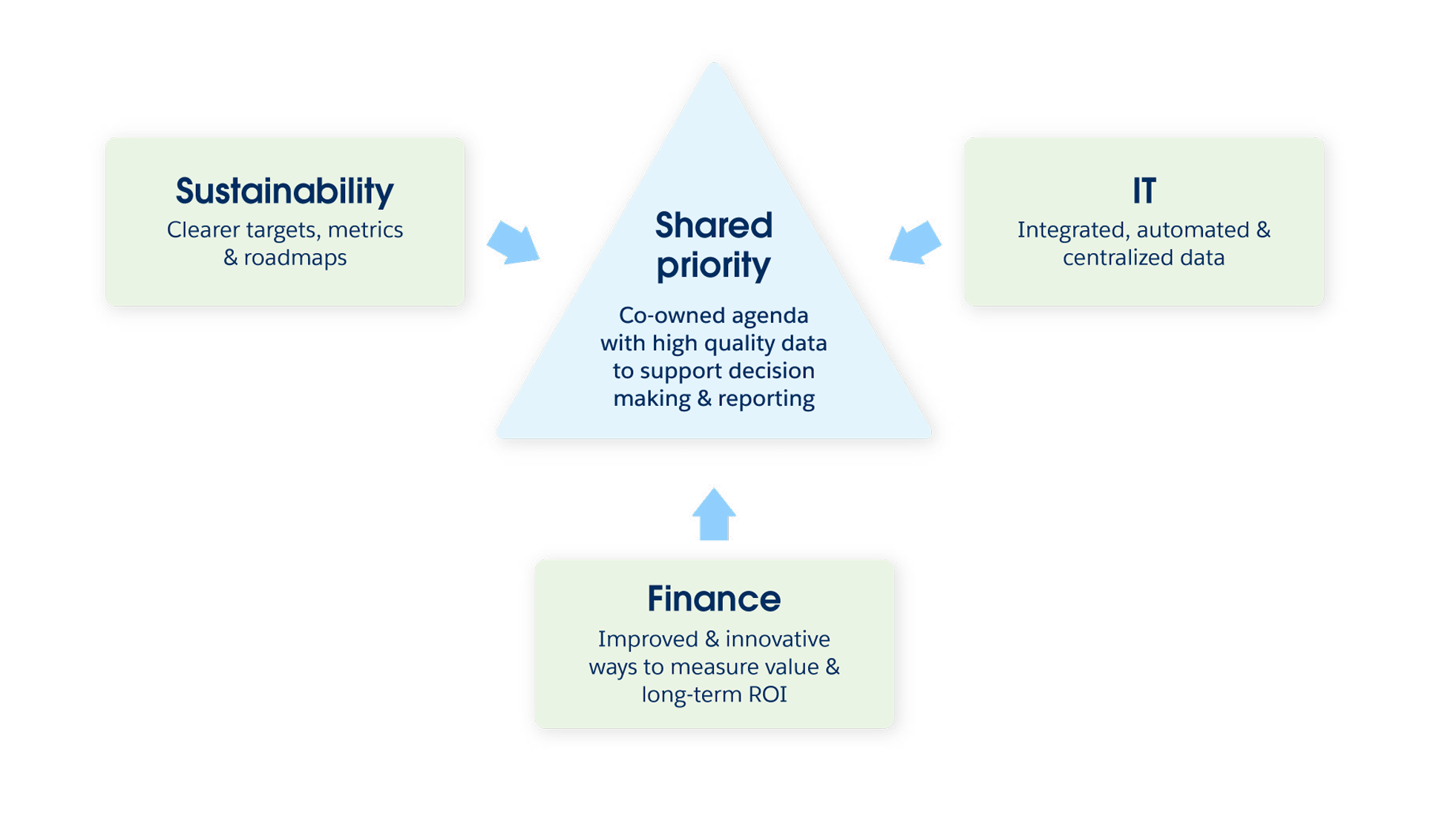
The Sustainability Value Triangle
The IT Imperative: Data and Digital Foundations
The IT function is pivotal to advancing sustainability integration and value creation by providing the technological infrastructure and data analytics required to track and optimise initiatives.
For integration to be effective, it requires robust data. This is where the IT function’s contribution to digital sustainability becomes non-negotiable. IT is required to provide improved, integrated, and/or automated data collection systems. These systems are essential to collecting, aggregating, storing, and displaying reliable and accurate sustainability data.
Currently, there is a significant data gap:
Only half of Advanced Integrators report having access to high-quality sustainability data, while only 18 percent of less-integrated peers can say the same.
High-quality, centralised data access (often facilitated by IT) is a key component of success for Advanced Integrators.
Ultimately, high-quality data, provided by IT, is the foundation needed to build confidence for action, craft compelling financial business cases, and justify necessary investment across the organisation.
Beyond Reporting: Addressing the Technology Footprint
While IT's primary demand from other functions is often centralised data and automated systems, IT leaders recognise that they must also address the environmental footprint of their own operations (digital sustainability).
IT infrastructure can account for the majority of Scope 1 and 2 emissions in certain industries, such as banking and insurance. The Sustainability function is thus looked to by IT peers for practical assistance in reducing technology’s carbon and e-waste footprints and for providing expertise to help minimise IT’s environmental footprint.
This digital capability is also key to innovation. While the application of Artificial Intelligence (AI) for sustainability is currently a lower priority for many, 50 percent of surveyed leaders expect AI to deliver more value over the next two years. IT is tasked with working with sustainability teams to guide the use of new tools like AI to increase innovative solutions for complex, systemic challenges, such as scenario planning and forecasting for sustainability goals.
Collaboration: The Foundation for Value Creation
The path to becoming an Advanced Integrator—and securing measurable commercial success—requires co-owning the sustainability agenda across the Sustainability Value Triangle.
When Finance, IT, and Sustainability collaborate effectively, the benefits are tangible:
Stronger Business Cases: Integration requires financial business cases and robust data to build confidence for effective decision-making on resource allocation. Finance must help co-develop innovative financial measures and long-term perspectives on ROI, moving beyond traditional short-term models.
Aligned Priorities: The most valuable areas for collaboration among the three functions revolve around coordinating and providing higher-quality data to drive management decisions and reporting requirements. This also includes aligning on funding elements and cost-benefit analyses.
Overcoming Barriers: While lack of resources (time and money) is a consistent barrier for Less-advanced Integrators, more mature organisations that have invested time and money into collaboration find this barrier less significant.
IT leaders are specifically seeking to be strategic partners, moving beyond mere data provisioning to become involved in strategic foundational elements like setting goals, priorities, and supporting key metrics in the development stage. However, this is challenging when IT faces the mindset that sustainability is a cost rather than an opportunity, requiring leaders to demonstrate how short-term investments in data systems can uncover efficiency savings.
Your Next Step: Become an Advanced Integrator
Integration is the decisive factor driving measurable value. Advanced Integrators consistently realise more value, achieving higher sales growth, driving innovation, and facilitating partnerships significantly better than their peers.
The message for Australian technology, finance, and sustainability professionals is clear: Implementation means embedding sustainability into decision-making, governance, and day-to-day operations—as part of the core. By committing to strong collaboration within the Sustainability Value Triangle, especially by enabling high-quality data flows through IT and co-owning the strategic agenda, your business can accelerate value creation and deliver genuine impact.
Is your organisation truly leveraging its digital capability to move from ambition to action?
References
Sustainability Value Triangle: Creating impact through Finance, IT, and Sustainability [Globe Scan Feb 2025]