Published on Sustainably Digital | November 28th , 2026
At our recent SFIA Week 2026 session—co-hosted alongside Mark Butcher from Posetiv Cloud and supported by the Australian Computer Society (ACS)—we tackled one of the most persistent bottlenecks in corporate decarbonisation: why digital sustainability initiatives so frequently stall.
Our webinar, titled “Unlocking Sustainable Technology & GreenOps with SFIA 9: Making GreenOps part of everyone’s job,” explored how organisations can move past cosmetic dashboards and siloed targets by connecting operational telemetry directly to governance, finance, and procurement.
For the sustainability, finance, and technology leaders reading this, here is a breakdown of why digital footprint management must evolve, how the tactical SFIA 9 Sustainable Technology and GreenOps view bridges the accountability gap, and which strategic SFIA 10 Change Requests are currently on the table to embed sustainability permanently across the digital profession globally.
What is SFIA? A Quick Primer for the Uninitiated
For professionals coming from sustainability or finance backgrounds who may not encounter it daily, SFIA (Skills Framework for the Information Age) is the globally recognised common language for digital, IT, and information economy capabilities.
Maintained by the non-profit SFIA Foundation, the framework defines professional skills and competencies mapped across seven progressive levels of responsibility:
Level 1 (Follow): Performing routine tasks under close supervision.
Level 2 (Assist): Performing routine activities under supervision with discretion to resolve basic issues.
Level 3 (Apply): Working under general direction to apply standard methods and complex tasks.
Level 4 (Enable): Performing complex technical activities and guiding others.
Level 5 (Ensure, advise): Providing authoritative guidance, accountable for significant work deliverables.
Level 6 (Initiate, influence): Making high-level decisions, shaping policies, and accepting accountability for strategic initiatives.
Level 7 (Set strategy, inspire, mobilise): Operating at the highest organisational level, determining overarching vision and strategy.
Each level is anchored by behavioural attributes—such as autonomy, influence, complexity, and knowledge—ensuring skills are defined by real-world capability and accountability rather than arbitrary job titles.
The Reality Check: Why GreenOps Stalls
In our webinar session, we defined GreenOps as “the discipline of making digital consumption visible, governable, and optimisable”. Digital consumption encompasses everything technology touches: electricity, embodied carbon in hardware, water used for data centre cooling, and generated electronic waste.
Historically, organisations respond to technology footprint pressures through three predictable steps:
Appoint a GreenOps or sustainability lead: Handing them a reduction target without giving them ownership over the services, budgets, or contracts that create the footprint.
Procure a carbon accounting tool: Modelling emissions based on spend data and cloud vendor proxy averages, which often mask reality and assign no operational accountability.
Publish a dashboard: Reporting the same unaddressed waste month after month to teams who have no mandate or incentive to alter their systems.
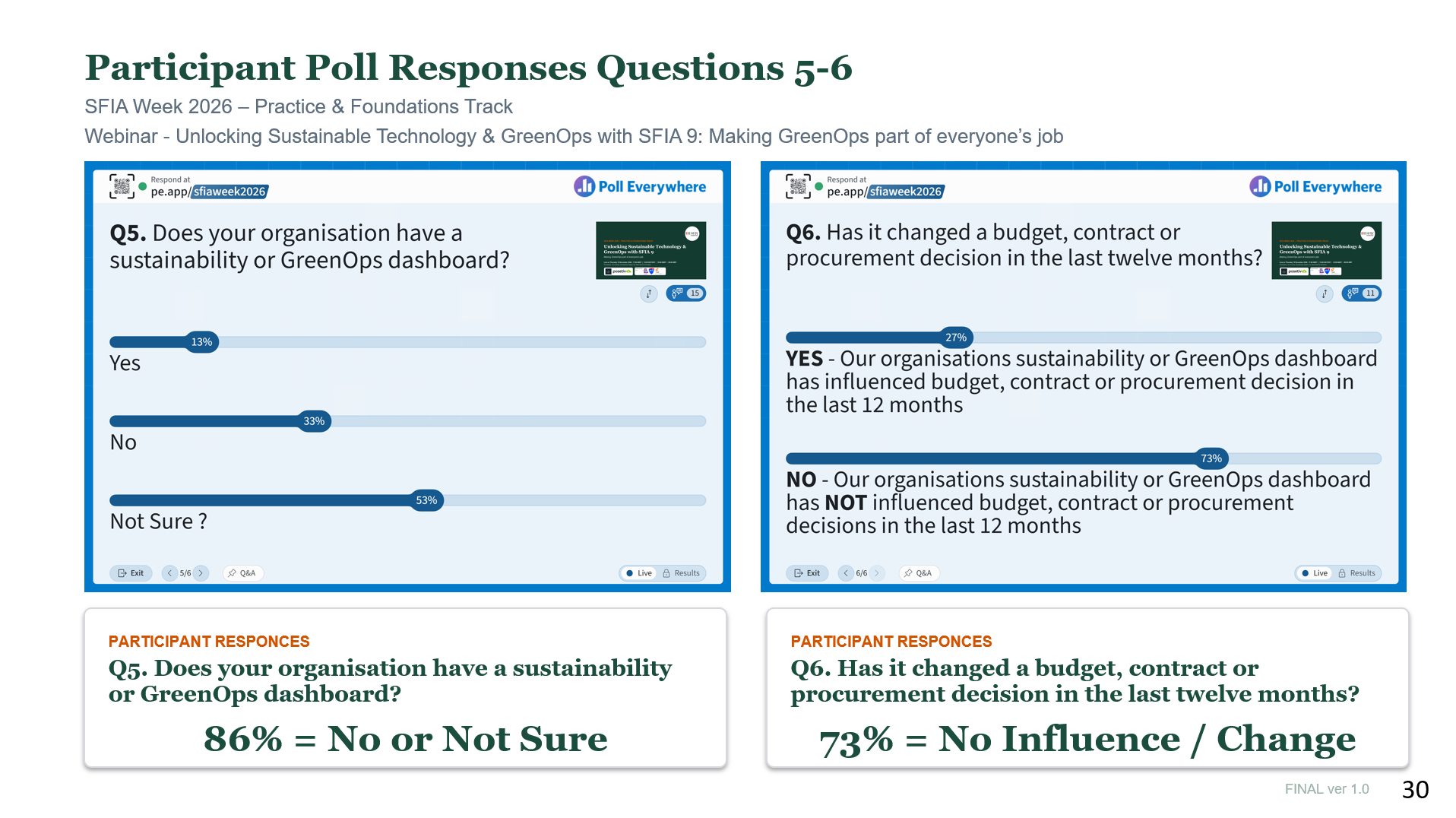
During our live session poll, 86% of attendees indicated their organisation either did not have a sustainability dashboard or were unsure if one existed. Crucially, of those with dashboards, 73% confirmed that the dashboard had not changed a single budget, contract, or procurement decision in the past 12 months.
The Accountability Break
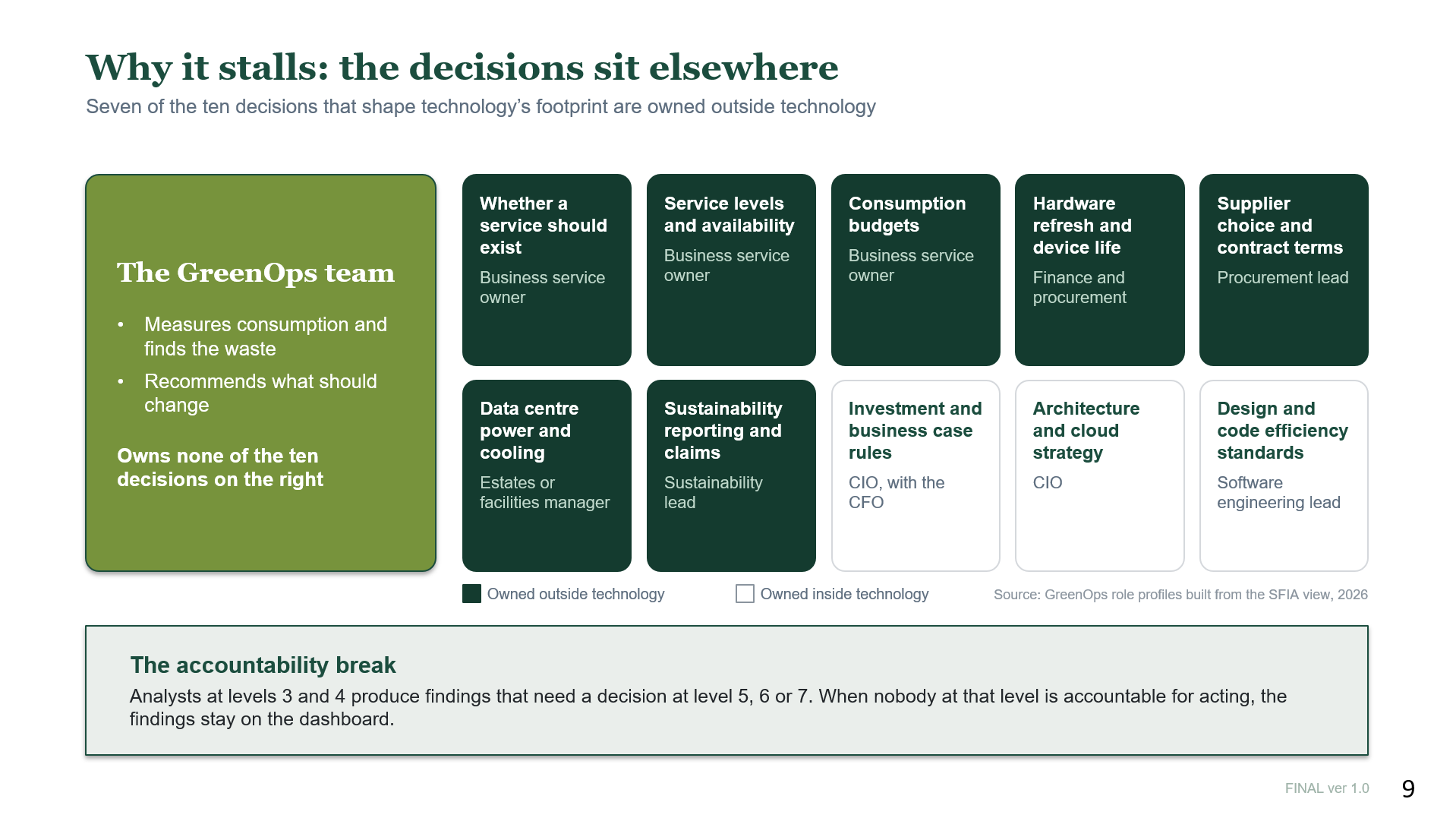
Why does this happen? Seven of the ten key decisions that dictate technology’s footprint sit entirely outside the core IT department:
Service Existence & Availability: Owned by Business Service Owners (SFIA Level 6).
Hardware Refresh & Lifecycle: Owned by Finance and Procurement.
Supplier Selection & Contract Terms: Owned by Procurement Leads.
Facility Power & Cooling Overhead: Owned by Estates or Facilities Managers.
Sustainability Reporting & Claims: Owned by Sustainability Leads.
Investment & Business Case Rules: Co-owned by the CIO and CFO.
This creates what we call the accountability break. Technical analysts at SFIA Levels 3 and 4 identify idle capacity or over-provisioned infrastructure, but the authority to accept operational risk or decommission services resides at Levels 5, 6, and 7. When decision-makers at those higher levels lack defined sustainability accountability in their role profiles, findings simply languish on dashboards.
The Sustainable Technology & GreenOps View on SFIA 9
To fix this disconnect, the SFIA Foundation released the Sustainable Technology and GreenOps View for SFIA 9. Rather than inventing new niche job titles that isolate responsibility, this view establishes that GreenOps is a function of everyone’s job.
Key highlights of the SFIA 9 view include:
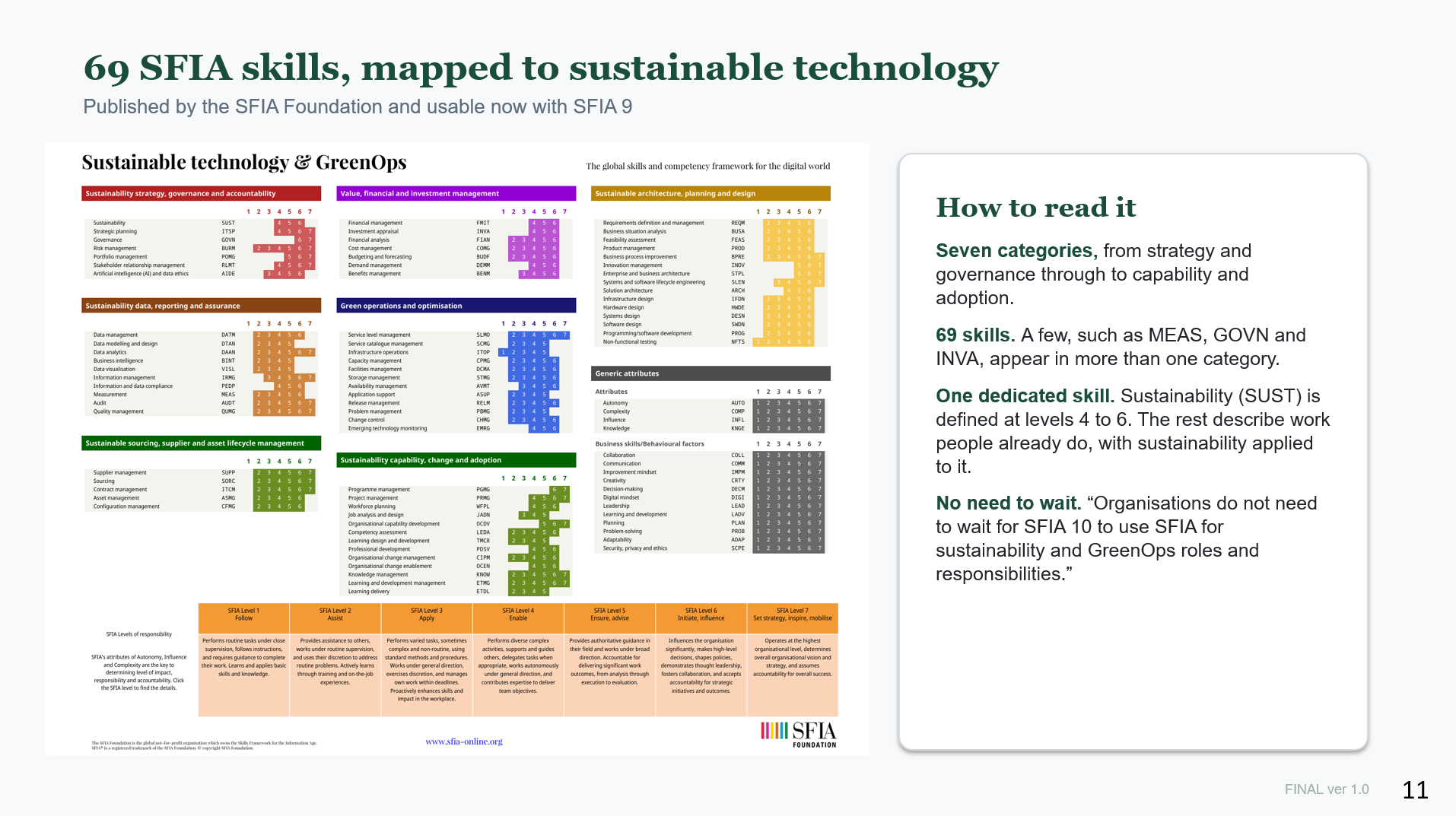
69 Mapped Skills: Demonstrating how environmental responsibility integrates across existing digital, operational, and commercial disciplines.
Seven Broad Categories: Spanning Strategy, governance and accountability; Value, financial and investment management; Sustainable architecture, planning and design; Sustainable sourcing, supplier and asset lifecycle management; Green operations and optimisation; Sustainability data, reporting and assurance; and Sustainability capability, change and adoption.
The Single Dedicated Skill (SUST): Within SFIA 9, the dedicated Sustainability (SUST) skill is defined only at Levels 4, 5, and 6. The remaining 68 skills describe core operational work (such as capacity management, financial management, or procurement) executed with sustainability criteria embedded.
12 Actionable Role Profiles: The view provides 12 standardised role profiles—7 inside technology (from GreenOps analysts to the Accountable Technology Owner) and 5 outside technology (Business Service Owner, Sustainability Lead, Technology Procurement Lead, Finance Business Partner, and Estates/Facilities Manager).
Upstream Design vs Downstream Operations
The view clearly differentiates where impacts are established and where they are controlled:
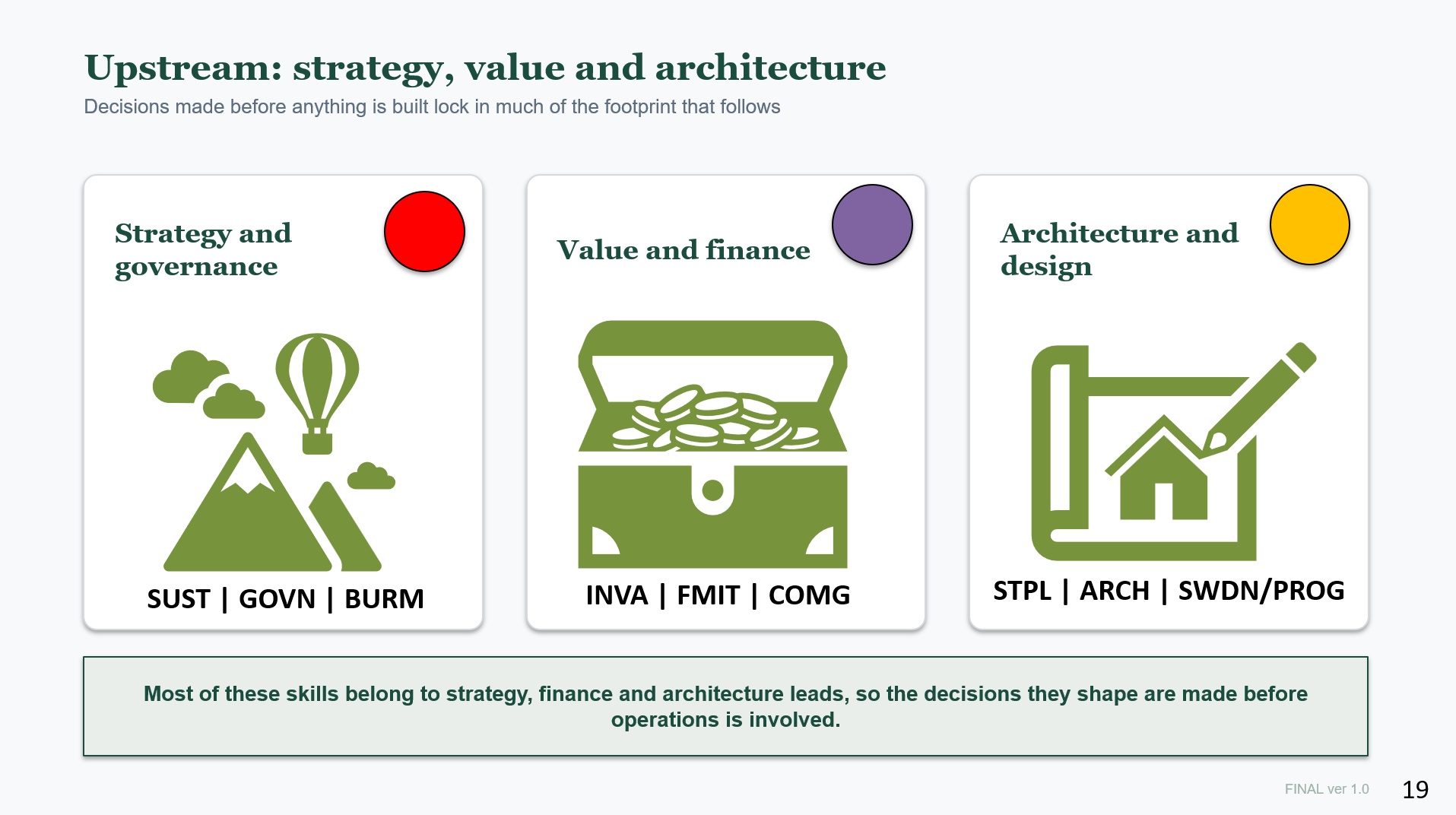
Upstream (Strategy, Value, and Architecture): Decisions made during strategic planning, architecture design (ARCH), and investment appraisal (INVA) permanently lock in the emissions profile of digital services long before code runs or infrastructure is provisioned. Incorporating whole-of-life carbon into initial business cases prevents runaway footprint downstream.
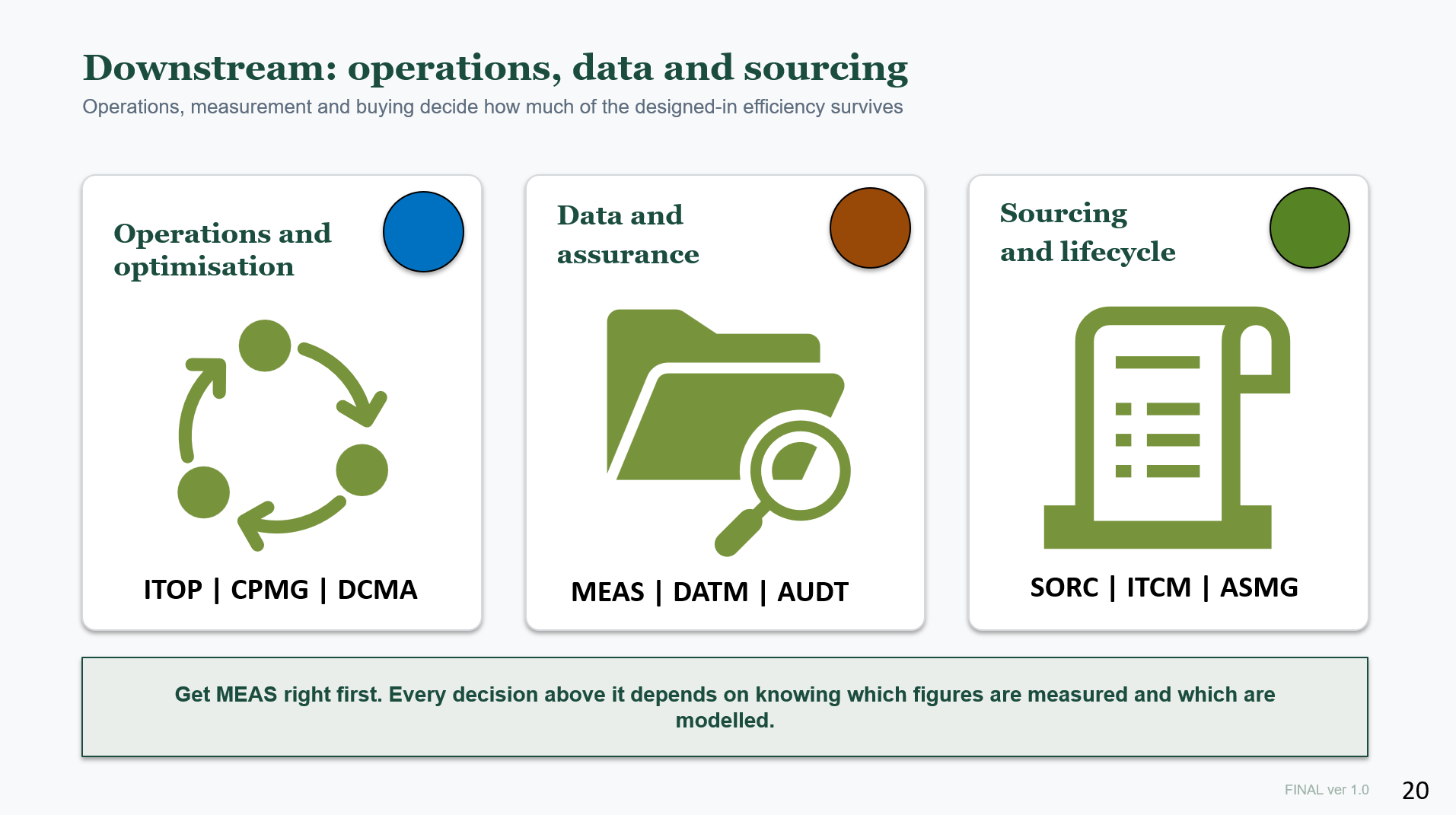
Downstream (Operations, Measurement, and Sourcing): Operational teams maintain or compromise that designed-in efficiency. Here, measurement (MEAS) and contract management (ITCM) are vital to separate actual metered telemetry from modelled estimates and secure contractual rights to granular emissions data from third-party suppliers.
Looking Ahead: Proposed SFIA 10 Change Requests
While the SFIA 9 view allows organisations to begin mapping responsibilities immediately, the current underlying skill definitions still contain gaps. Because the SFIA framework operates on a three-year revision cycle, the upcoming SFIA 10 release represents the primary window until 2030/2031 to formalise sustainability competencies directly into the standard descriptions.
Through our work with the ACS Sustainability Technical Advisory Board, we have submitted and championed key Change Requests (CRs) to the SFIA Design Authority:
1. Expanding Core Sustainability & Governance Levels
#1565 (Sustainability - SUST): Extends SUST downwards to Levels 1–3 to establish clear career pathways for junior staff handling energy records and data collection, while consulting on adding Level 7 so that executive board-level accountability is formally defined.
#1599 (Audit & Governance - AUDT, GOVN): Adds ESG regulatory assurance to Audit (AUDT) and extends Governance (GOVN) down to Levels 4 and 5.
#1594 (ESG Reporting): Broadens framework coverage of carbon data, reporting capabilities, and regulatory assurance.
2. Embedding Financial Transparency & Commercial Data Rights
#1600 & #1617 (Financial Management & Cost Management - FMIT, COMG): Embeds carbon accounting, Scope 1–3 modelling, and environmental showback (carbon, energy, water) directly alongside monetary spend, moving away from flawed spend-proxy calculations.
#1616 (Contract Management - ITCM): Formalises requirements for contractual environmental data rights, audit clauses, and strict hardware end-of-life disposition terms in supplier agreements.
#1615 (Asset Management - ASMG): Embeds tracking of embodied carbon, hardware lifecycle extension policies, refurbishment, and circular economy disposal practices.
3. Addressing High-Density AI Compute & Engineering Practice
#1614 (Operations & Infrastructure - ITOP, IFDN, CPMG): Directly incorporates AI infrastructure demands, high-density compute rack operations, accelerator/GPU utilisation metrics, and liquid cooling considerations.
#1618 (Facilities Management - DCMA): Separates IT workload management from facility overhead and incorporates site-level efficiency metrics (PUE, WUE, CUE).
#1619 (Demand Management - DEMM): Embeds active demand challenge, service-tier trade-offs, and the systematic retirement of dormant applications and dark data.
#1620 (Measurement - MEAS): Mandates telemetry data lineage and enforces a strict distinction between directly measured telemetry and modelled approximations.
#1621 (Software Design & Development - SWDN, PROG, NFTS, SLEN): Introduces resource-aware code design, energy efficiency testing, and automated lifecycle shutdown for on-demand non-production environments.
#1613 (Risk Management - BURM): Integrates physical climate hazards, grid dependencies, water constraints, and AI power availability into standard risk assessments.
What You Can Do Next
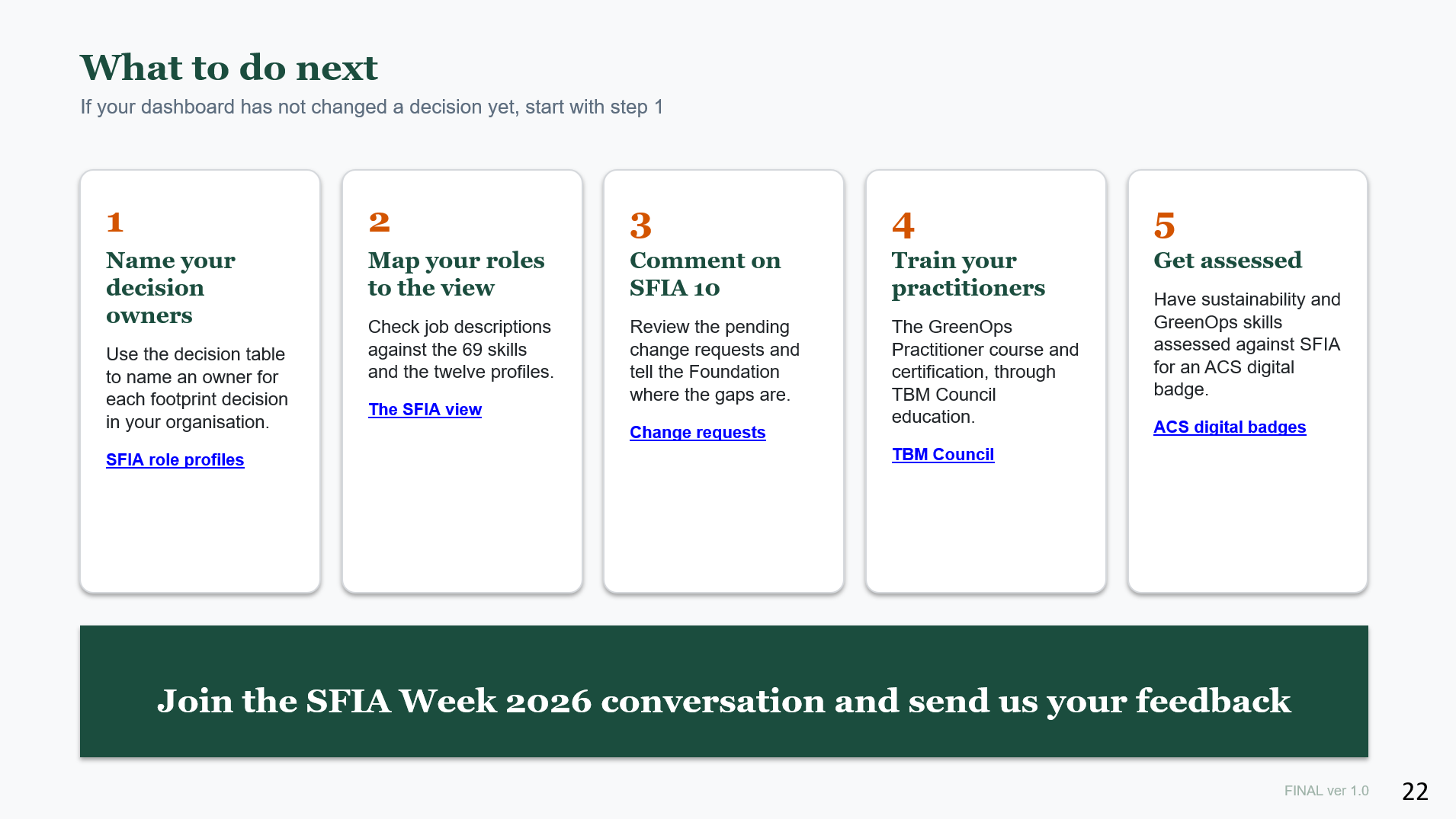
Bridging the accountability gap does not require waiting for future standards—organisations can execute practical interventions today:
Name your decision owners: Use the 10-decision framework to assign explicit ownership across business, finance, estates, and procurement leaders.
Map internal roles to the SFIA 9 view: Cross-reference current position descriptions against the 12 published profiles to locate your operational gaps.
Upskill cross-functional teams: Explore practitioner education, such as the 17-module GreenOps Practitioner Course through TBM Council education, and pursue independent skills validation via ACS SFIA digital badging.
Have your say on SFIA 10: Visit the SFIA Foundation change request portal and provide feedback on the pending sustainability CRs before the consultation window closes in early 2027.