Turning Digital Waste into $16.1M: The ‘Horizon Pacific Bank’ GreenOps Case Study
Published on Sustainably Digital | May 22, 2026
Today, we are diving into a compelling case study that perfectly illustrates the intersection of technology, finance, and sustainability.
For Tier-2 challenger banks, every dollar of capital efficiency and every point of reputational differentiation is a strategic asset. Recently, Horizon Pacific Bank mapped out a formal Digital Sustainability (GreenOps) programme that proves sustainable IT isn't just an environmental imperative—it’s a financial and regulatory necessity.
If you are a CIO battling digital entropy, a CFO looking for capital efficiency, or a Chief Sustainability Officer (CSO) navigating Australia's strict new climate disclosure laws, this case study is your blueprint.
The Financial Case: Eliminating "Digital Entropy"
Horizon Pacific Bank operates with an annual IT spend of $160m—typical for a digitally progressive, growth-focused regional bank. However, industry benchmarks show that organisations without active waste management lose 8–15% of their IT spend to idle compute, over-provisioned storage, and unused SaaS licenses.
By targeting a conservative 5% waste reduction, the bank identified an astonishing $8m in annual waste value at risk.
Here is the breakdown of the financial opportunity:
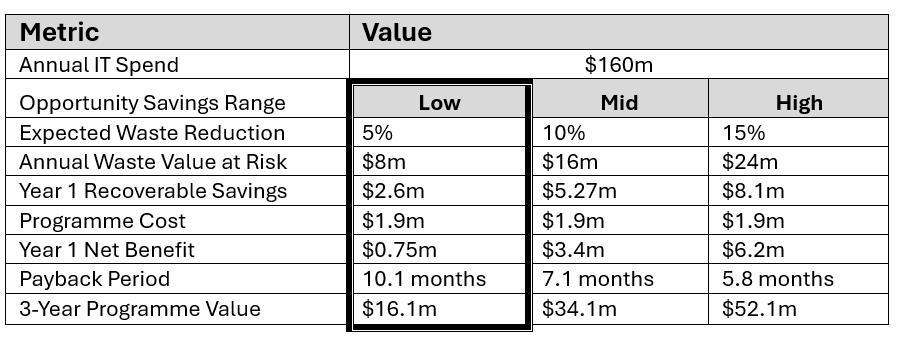
“The 10.1-month payback is not an aspiration — it is a floor."
But direct cost reduction is only one of four financial levers the bank identified:
1. Immediate Cost Reduction: Rationalising SaaS and rightsizing cloud infrastructure.
2. Improved Total Cost of Ownership (TCO): Extending device refresh cycles and prioritising circular procurement (crucial, as hardware absorbs ~40% of their IT budget).
3. Green Financing Access: Unlocking sustainability-linked loans and tapping into Australia's $30bn+ green bond market for a lower cost of capital.
4. Revenue and Market Access: Winning enterprise and public sector mandates that now strictly require evidence-based ESG credentials.
The Risk Case: The Regulatory Tide Has Turned
For the finance and sustainability professionals reading this, the cost savings are great, but the risk mitigation is where this business case becomes a board-level mandate.
Australia’s mandatory climate disclosure regime (aligned with AASB, IFRS S1/S2) is now in full effect. Enforced by the Australian Securities and Investments Commission (ASIC), non-compliance is no longer a mere reputational hiccup—it is a massive civil and criminal liability event.
Without credible, auditable sustainability data from their IT operations, organisations face unprecedented penalties:

Crucially, director personal liability applies if executives fail to make accurate declarations confirming that sustainability reports meet legal requirements. Furthermore, proven dishonesty or intentional failure to maintain records can lead to criminal offences, including imprisonment.
ASIC possesses broad enforcement powers, including audit authority, stop orders, and the ability to demand expedited corrective market updates. In this environment, a $1.9m investment in GreenOps is a remarkably cheap insurance policy against an existential regulatory threat.
The Verdict: Bridging the Silos
The Horizon Pacific Bank case study proves that Digital Sustainability is the ultimate unifier for the C-suite.
For the CIO: It funds modernisation by eliminating digital waste.
For the CFO: It improves the IT cost-to-income ratio, accesses cheaper green capital, and delivers a 10-month ROI.
For the CSO: It provides the auditable, board-endorsed data required to survive ASIC's rigorous new disclosure regime.
At sustainably digital, we believe the future of enterprise tech is lean, green, and highly governed. Horizon Pacific Bank isn't just saving money; they are claiming strategic ground as a sustainability-credible challenger in a fiercely competitive market.
Are you tracking the carbon footprint and financial waste of your digital infrastructure?