The Sustainable IT ESG Standards V2.0 Are Here — What IT and Sustainability Leaders Need to Know
Posted by Tim Prosser | Founding Director, Sustainably Digital
If you work at the intersection of technology and sustainability, February 2026 marks a significant milestone. SustainableIT.org — the CIO and CTO-led non profit that has been building the definitive ESG standards framework for enterprise IT — has released Version 2.0 of its Sustainable IT Standards Taxonomy. This is the most comprehensive update to the framework since it was first published in 2023, and it arrives at a critical moment for both the IT profession and the broader sustainability landscape.
Whether you are a Chief Information Officer building out your sustainability roadmap, a sustainability officer trying to bring IT into your ESG reporting, or a technology professional wondering how your work connects to your organisation's climate commitments — this update deserves your attention.
What Is the Sustainable IT Standards Taxonomy?
Before diving into what's new, it's worth grounding ourselves in what this framework actually is.
The Sustainable IT Standards Taxonomy is a set of IT-tailored metrics and topics for environmental, social, and governance (ESG) sustainability. It operates across two distinct but complementary dimensions:
Sustainability in IT — how IT functions manage their own environmental and social footprint (data centres, devices, e-waste, workforce diversity, and more)
Sustainability by IT — how technology teams enable and accelerate sustainability outcomes across the broader enterprise (smart buildings, transportation emissions, digital supply chains, and beyond)
This dual lens is what makes the Sustainable IT framework unique. While mainstream reporting frameworks like the Global Reporting Initiative (GRI), the Sustainability Accounting Standards Board (SASB), and the European Sustainability Reporting Standards (ESRS) are valuable for enterprise-level goal-setting and disclosure, they are not granular or relevant enough for IT leaders who need to understand exactly which levers they can pull. The Sustainable IT taxonomy fills that gap — and it does so while mapping back to those established frameworks, so your efforts remain aligned with regulatory and investor expectations.
Why Version 2.0, and Why Now?
The journey to V2.0 has been a steady, methodical one. The first environmental standards were published in March 2023, followed quickly by social and governance standards. Subsequent updates added new metrics, corrected discrepancies, and expanded alignment to the UN Sustainable Development Goals (SDGs), the UN Global Compact, and CSRD regulation codes.
But V2.0, released in January 2026, is a major leap. The timing is no coincidence. The sustainability and technology landscape has shifted dramatically over the past two years. AI has moved from an emerging concern to a central operational reality with measurable environmental costs. Water scarcity has moved up the corporate risk agenda. Circular economy principles are increasingly embedded in regulatory expectations. And the publication of *The Sustainable IT Playbook, 2nd Edition* — also released in early 2026 — provided a new operational framework of ten enterprise use cases for "sustainability by IT" that directly informed this standards update.
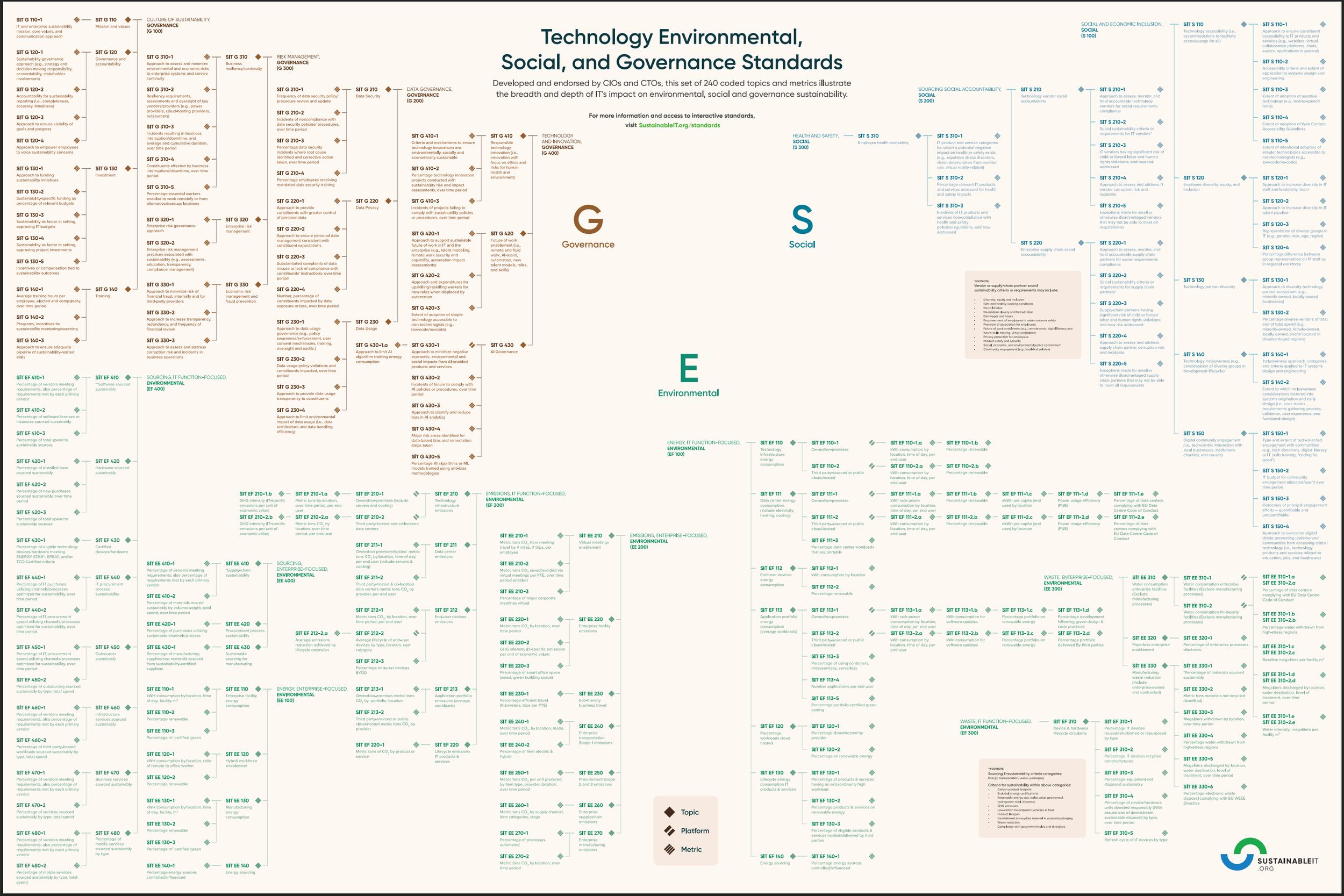
ESG IT Standards Landscape - Courtesy Sustainable IT
What's New in V2.0? A Summary for Professionals
Here is a breakdown of the most significant changes and additions in the V2.0 release.
🤖 Responsible and Sustainable AI Governance
This is arguably the headline addition of V2.0, and it is long overdue. As AI systems become embedded in enterprise operations — from inference engines running continuously in the cloud to large-scale model training events — their environmental and governance footprints can no longer be ignored.
V2.0 introduces new standards covering:
AI systems energy consumption — tracking the energy used by AI training and inference workloads
AI compute water usage — recognising that cooling AI infrastructure draws heavily on water resources
Water-aware workload management — a forward-thinking standard that encourages IT teams to schedule compute-intensive tasks in ways that minimise water consumption
Responsible AI governance — now formally included in the Governance standards, aligning with frameworks like the NIST AI Risk Management Framework (AI RMF) and ISO/IEC 42001
For IT leaders navigating the EU AI Act alongside their ESG commitments, this governance standard provides a practical bridge between regulatory compliance and sustainability reporting.
💧 Water Sustainability Standards
Water has been an underrepresented dimension of IT sustainability, but data centres are significant water consumers — both for direct cooling and through the energy systems that power them. V2.0 formally introduces Water Usage Effectiveness (WUE) metrics for technology infrastructure. This includes:
Water consumption tracking for owned and third-party hosted infrastructure
Biodiversity impact considerations connected to water sourcing and discharge
This brings the Sustainable IT taxonomy into closer alignment with the growing emphasis on water stewardship in frameworks like the CDP Water Security questionnaire and the ESRS E3 standard.
♻️ Technology Circularity (Expanded)
What was previously categorised under "Waste" has been significantly expanded and reframed as Circularity — a more accurate and ambitious framing. V2.0 deepens the standards around:
Hardware lifecycle management and critical materials circularity
Certified device procurement
E-waste elimination strategies
For IT procurement and asset management teams, this represents a clearer set of metrics to track and report on as circular economy expectations tighten across regulatory environments.
🏭 Sourcing Standards — Now a Dedicated Section
Environmental and social sourcing standards have been elevated in V2.0 with a dedicated section: Environmental Standards – Sourcing the Data. This reflects the growing recognition that a significant portion of IT's environmental and social impact lives in the supply chain — from the minerals mined for hardware to the labor practices of technology vendors.
New and expanded sourcing standards cover:
Tech vendor sourcing for environmental impact
Supply chain human rights requirements
Vendor human rights requirements
Sourcing governance accountability
For sustainability professionals working on Scope 3 emissions reporting or supply chain due diligence under the EU Corporate Sustainability Due Diligence Directive (CSDDD), these standards provide a practical, IT-specific complement to your existing frameworks.
🌍 Enterprise-Level Environmental Standards — Aligned to 10 Use Cases
Several new standards topics and categories have been added to the Environmental – Enterprise (Sustainability by IT) section, directly aligned with the ten use cases for "sustainability by IT" detailed in The Sustainable IT Playbook, 2nd Edition. This includes expanded coverage of:
E-services deployment and digital product sustainability
Enterprise facility energy and emissions enabled by IT
Hybrid work enablement as an emissions-reduction lever
Enterprise transportation emissions managed through technology
Enterprise materials circularity and water consumption supported by digital tools
This section reinforces the message that IT is not merely a cost centre managing its own footprint — it is an enterprise-wide enabler of sustainability transformation.
The Full Scope: ESG Standards at a Glance
For those new to the framework, here is a high-level view of how the V2.0 standards are organised across the three ESG pillars:
1.Environmental
IT Function - Energy & emissions (data centres, devices, AI), circularity, water usage, biodiversity, sourcing
Enterprise - Facility energy, hybrid work, transportation, materials circularity, e-services, digital products
2. Social
Technology accessibility, inclusive design, IT workforce DEI, vendor diversity, digital divide, health & safety, human rights
3.Governance
Culture of sustainability, data privacy & security, digital resilience, ESG risk management, responsible AI governance, responsible innovation
Social and governance standards apply both within IT and to the enterprise at large — an important nuance for sustainability officers who need to engage IT as a partner in enterprise-wide ESG commitments.
How Should IT and Sustainability Professionals Use These Standards?
The Sustainable IT taxonomy is not a compliance checklist — it is a strategic tool. Here is how to put V2.0 to work:
1. Start with a materiality assessment.
Not every standard will be equally relevant to your organisation. Sustainable IT recommends mapping standards against two axes: importance to business and stakeholder impact. High-priority areas for most organisations typically include IT infrastructure energy and emissions, data privacy and security governance, business resilience, and electronic waste reduction.
2. Select your priority topics and adopt the associated metrics.
IT leaders should choose from the taxonomy the topics most aligned to enterprise sustainability goals and current reporting obligations. The metrics provide a consistent basis for baselining, tracking, and reporting progress.
3. Align to your enterprise reporting framework.
Because V2.0 maintains mappings to ESRS, GRI, SASB, UN SDGs, and UN Global Compact benchmarks, the metrics you adopt can feed directly into your broader ESG disclosure processes. This is particularly valuable for organisations navigating CSRD compliance.
4. Use the AI and water standards proactively.
Even if your organisation is not yet required to report on AI energy consumption or water usage, establishing baseline measurements now will position you ahead of emerging regulations and investor expectations. The time to instrument these systems is before they are mandated.
5. Engage your technology vendors.
The sourcing standards are only as powerful as the conversations they drive with suppliers. Use the V2.0 sourcing standards as a framework for vendor sustainability questionnaires, procurement criteria, and partnership expectations.
A Framework Built by IT Leaders, for IT Leaders
One of the most important things to understand about the Sustainable IT standards is who built them. This framework was developed by global CIOs and CTOs — technology executives who understand both the operational realities of running IT and the strategic imperative of ESG accountability. That practitioner perspective makes the taxonomy meaningfully different from top-down regulatory frameworks that, while important, often lack the granularity that IT teams need to act.
The standards are designed to be universal — relevant to IT functions across any region, any industry, and any size of organisation. Whether you are managing a global hyperscaler relationship or trying to reduce the e-waste footprint of a mid-sized enterprise, the taxonomy provides a starting point.
The Bottom Line
The release of Sustainable IT Standards V2.0 is a substantive advancement for the field of digital sustainability. The additions of AI governance and environmental footprint standards, water sustainability metrics, expanded circularity frameworks, and enterprise-level standards aligned to real-world use cases make this the most actionable and comprehensive version of the taxonomy to date.
For IT professionals, this is your framework. It speaks your language, maps to your operational decisions, and gives you the metrics you need to demonstrate that technology is not just part of the sustainability problem — it is a critical part of the solution.
For sustainability professionals, this is your bridge into IT. If you have struggled to get your technology teams engaged in ESG strategy, the Sustainable IT taxonomy gives you a credible, IT-native conversation starter — one that connects the work your tech colleagues do every day to the sustainability outcomes your organisation has committed to delivering.
The standards are available now at SustainableIT.org. We encourage every IT and sustainability leader to explore them, assess their relevance to your organisation, and begin putting them to work.
Resources