Confronting the Elephant in the Room: AI, Data Centres, and the Path to True Digital Sustainability
Posted by Tim Prosser | Founding Director, Sustainably Digital
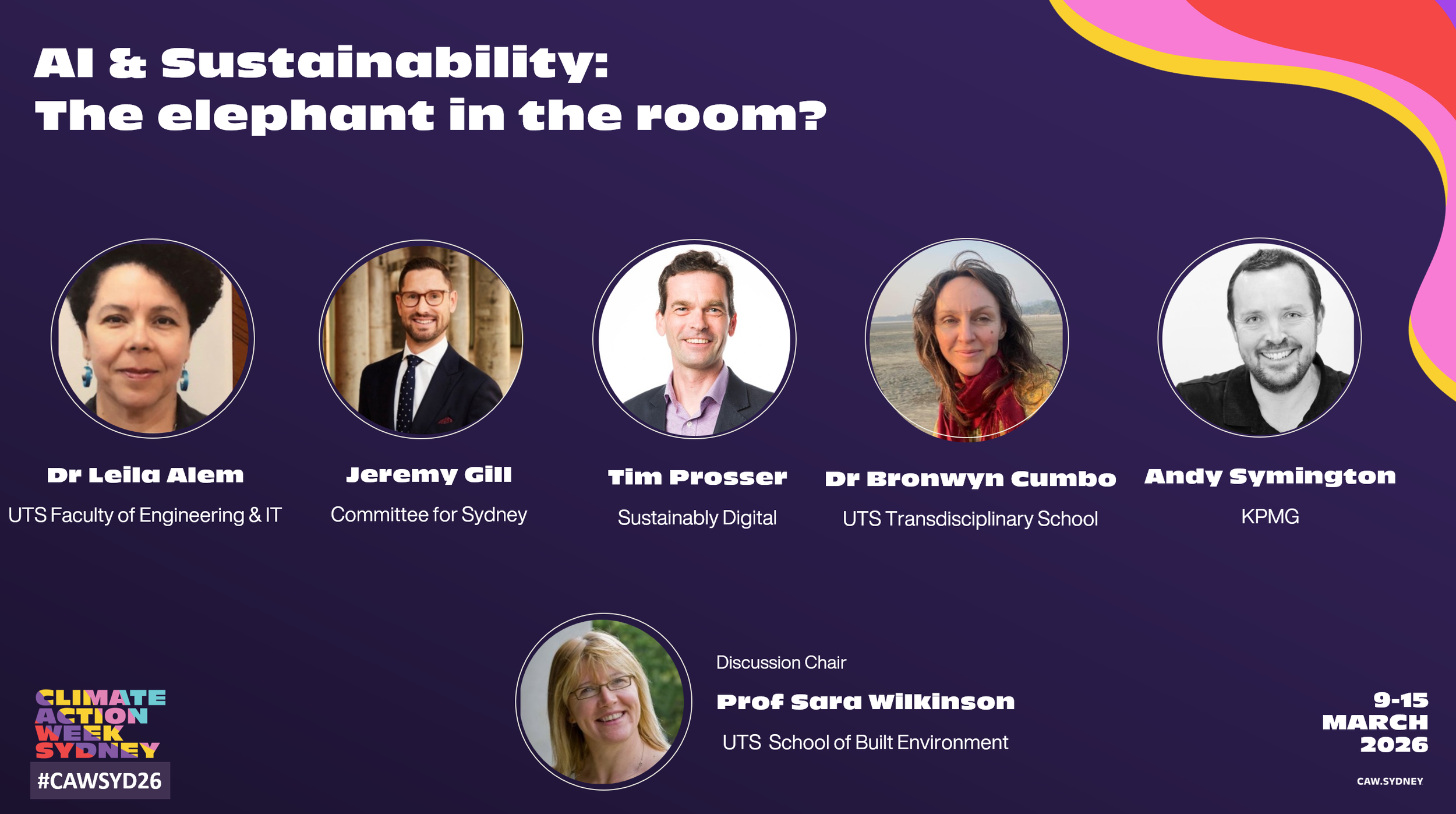
Last week I had the privilege of taking the stage at EnergyLab in Haymarket situated within the University of Technology Sydney (UTS) for a standout event during Climate Action Week Sydney 2026. The panel, expertly chaired by Professor Sara Wilkinson, tackled a provocative and timely theme: "AI & Sustainability: The elephant in the room?".
As digital sustainability professionals, we constantly battle the technological illusion of "The Cloud"—a term that sounds weightless, clean, and invisible. However, part of our job is to make the invisible visible. The physical infrastructure driving today's AI boom is incredibly heavy, resource-intensive, and growing at an unprecedented rate.
During my segment, I highlighted the fundamental dilemma of sustainable IT: we must balance the "handprint" (the brilliant solutions AI enables, such as optimising energy grids and transport) with its "footprint" (the environmental damage caused by the physical hardware and data centres).
The reality of that footprint is staggering, especially here in our own backyard. Currently, roughly 50% of Australia's planned data centre capacity is concentrated in Sydney. By 2030, these data centres are projected to consume 11% of Sydney's grid-supplied electricity and a massive 25% of the City of Sydney's drinking water. Furthermore, globally, our digital habits already consume 55% of our per capita carrying capacity for vital mineral and metal resources.
The conversation with my fellow panellists was deeply interconnected, highlighting that digital sustainability is about much more than just carbon:
Jeremy Gill, Head of Policy at the Committee for Sydney, emphasised the pressing need for strategic land-use planning to ensure the AI revolution doesn't compromise our dry continent's water and energy security.
Andy Symington, KPMG’s global Just Transition lead, discussed the risks of algorithmic bias and stressed that we must learn from the early missteps of the renewable energy rollout by embedding genuine community consultation and equity into tech infrastructure.
Dr. Leila Alem, a systems thinker and Adjunct Professor at UTS, championed the concept of "Human-first AI," challenging us to govern these automating systems so they don't leave people behind or exacerbate the digital divide.
Dr. Bronwyn Cumbo, a transdisciplinary researcher at UTS, brought vital attention to the lived realities, priorities, and values of the local communities actually residing alongside these massive data centre clusters.
So, how do we fix this? How do we ensure AI's benefits truly outweigh its environmental costs? I proposed three non-negotiable shifts that every organisation invested in digital transformation needs to champion:
1.Demand Policy with Teeth
Voluntary sustainability pledges from operators are no longer enough. We need mandates requiring data centres to be powered by 100% additional renewable energy. Tech giants cannot just buy up existing green energy; they must actively fund new local infrastructure, like the rooftop solar initiatives currently being explored in Sydney's Southern Enterprise Area.
2. Look Beyond Carbon to the Circular Economy
Decarbonising the grid is often treated as a silver bullet, but running a data centre on green energy doesn't solve its massive drain on our drinking water or critical minerals. We must mandate material circularity for hardware and require developer contributions to finance local water recycling for server cooling.
3. Implement Honest, Granular Measurement
You cannot manage what you cannot see. Too many companies still estimate their IT emissions based purely on financial spend. When companies switch to granular tracking of their actual electricity and hardware usage, they often find their true emissions are drastically different from their estimates. We need to eliminate these massive blind spots to achieve real Net Zero goals.
Australia recently ranked second globally for data centre investment. We have a once-in-a-generation window to shape this booming sector. The framework exists and the data is public—we can either build it right to strengthen our green transition, or we can let it cannibalise our progress and build community resentment.
Thank you to everyone who joined us at EnergyLab and contributed to such a critical conversation. Let’s keep pushing for a truly sustainable digital future.
Resources: